Foundation crack repair in Houston depends on what caused the crack. A narrow, stable crack in a slab can be sealed with an epoxy or polyurethane injection, which national figures put at about $250 to $800. A crack that keeps widening, runs horizontally, or comes with sticking doors and sloping floors usually means the slab is moving, and the fix is piers under the house to stop that movement. This page covers which cracks matter, how each kind gets repaired, what it costs here, and when to get a contractor out to look.
How does a cracked foundation get fixed?
A cracked foundation gets fixed in one of two ways. If the crack is narrow and has stopped moving, a contractor seals it with an injected epoxy or polyurethane, which blocks moisture and restores the surface. If the ground under the house is still shifting, sealing alone fails, so the contractor installs piers to support the slab, lifts it toward level, and then seals the cracks that remain.
Injection does nothing about the pressure that opened the crack, so on Houston clay a crack sealed over active settlement often reopens.
A typical visit:
- Look and measure. Crack width, any offset, sloping floors and sticking doors.
- Find the cause. Poor drainage, a plumbing leak under the slab, tree roots and dry soil are the usual suspects here.
- Choose the repair. Sealing for a stable crack, piers for a moving foundation, and drainage work when water is the trigger.
- Price it in writing before any work starts.
In the City of Houston, foundation repair needs a building permit, and the weekly city permit reports list them by the dozen. For a step-by-step view of the work itself, see how a cracked foundation is repaired.
How big is too big for a foundation crack?
A crack wider than about 1/4 inch is one of the signs that it may be structural, according to This Old House. Width is only part of the story, though. A crack that keeps growing, has one edge sitting higher than the other, or appears alongside sloping floors or sticking doors matters more than a wider crack that has stayed the same for years.
Very fine hairline cracks are common in concrete slabs as they cure and dry. They are usually cosmetic.
To tell whether a crack is active, pencil a mark and the date at each end and photograph it beside a ruler. If it grows past the marks within a few weeks, it is moving. Our guide on when foundation cracks are worth worrying about goes through the warning signs in more detail.
What are the different types of foundation cracks?
Foundation cracks fall into a few patterns. Vertical cracks are often linked to normal shrinkage and settling. Diagonal cracks usually form when one part of the foundation settles more than another. Horizontal cracks are the most concerning, because they point to pressure pushing on the foundation from outside. In brick veneer, a stair-step crack along the mortar joints usually means the slab beneath that wall has moved.
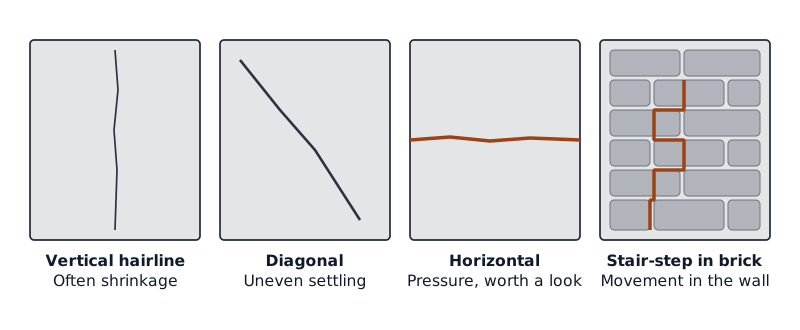
How each shows up in a Houston home:
- Hairline cracks in the slab surface, often under flooring or in the garage. Mostly shrinkage from when the concrete cured.
- Vertical cracks in the slab edge or grade beam. Often stable, but worth sealing to keep moisture out.
- Diagonal cracks running from the corners of doors and windows, inside or out.
- Stair-step cracks in exterior brick. A common sign of a dropped corner. See stair-step cracks in brick walls.
- Horizontal cracks. Most common in retaining or below-grade walls elsewhere in the country. Houston homes rarely have a basement, so here they turn up mostly in block or brick walls under pressure.
The differences between the two main directions are covered in vertical vs horizontal foundation cracks, and pictures of normal foundation cracks shows what usually needs no repair.
How much does foundation crack repair cost in Houston?
Sealing a single crack typically costs about $250 to $800, based on a national 2026 cost guide. If the crack is a symptom of settlement and the slab needs piers, the job moves into the range most Houston foundation repairs fall in, about $3,300 to $6,800. The number of piers, interior access and how far the slab has dropped drive the final price.
| Work | Typical range | Source |
|---|---|---|
| Crack filling or injection | $250 to $800 | National guide, 2026 |
| Sealing and waterproofing | $2,300 to $7,300 | National guide, 2026 |
| Concrete pier, each | $300 to $600 | Houston guide, 2026 |
| Steel pier, each | $1,000 and up | Houston guide, 2026 |
| Foundation inspection | $300 to $1,000 | Houston guide, 2026 |
| Structural engineer report | $500 to $1,000 | National guide, 2026 |
| Typical Houston foundation repair | $3,300 to $6,800 | Houston guide, 2026 |
These are guides, not quotes. The contractor prices your house after seeing it. The same national guide notes that a hairline crack sealed for a few hundred dollars can grow into a $10,000 to $15,000 repair if the movement behind it is left alone. There's a full breakdown on the foundation crack repair cost page.
Can Flex Seal or a DIY kit fix foundation cracks?
Flex Seal and similar spray coatings can cover a hairline crack on the outside of a slab and slow moisture getting in, but they are surface coatings. They do not bond the concrete back together or stop the slab from moving. A DIY injection kit does a better job on a narrow, dry, stable crack. Neither fixes a crack caused by settlement or soil pressure.
DIY is reasonable when the crack is narrow, your pencil marks show it has stopped growing, and floors and doors are fine.
Hydraulic cement fills visible cracks in masonry or concrete block, but it is usually cosmetic, according to This Old House. The trade-offs between the main fillers are in hydraulic cement for foundation cracks and epoxy injection for foundation cracks.
Call a professional when the crack is wider than about 1/4 inch, one side is offset, it keeps coming back, or the house shows other signs of movement.
What happens if you don't fix a cracked foundation?
A stable hairline crack left alone usually stays cosmetic. A crack caused by movement tends to get worse: it widens, lets moisture reach the steel inside the slab, and spreads into drywall, brick and door frames. The longer the slab keeps moving, the more piers it may need, and the more interior finishes need repairing once it's leveled.
Water is the main risk: moisture getting under flooring or into a wall cavity can cost more to put right than the crack itself.
Why do foundations crack so often in Houston?
Most Houston foundations crack because of the soil they sit on. Much of the area is heavy clay that swells when wet and shrinks when dry. The USDA describes Lake Charles clay, found across southeast Texas, as 45 to 60% clay, cracking 1/2 to 2 inches wide at the surface in dry spells. That constant swelling and shrinking puts uneven pressure on a slab.
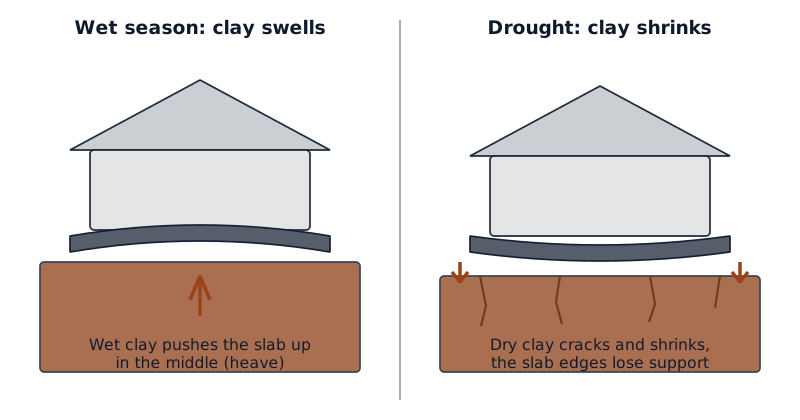
Three local factors add to it:
- Moisture swings. Long dry summers followed by heavy rain move the soil under the edges of a slab more than the middle.
- Subsidence. The Harris-Galveston Subsidence District measured the fastest sinking, over 3 cm a year, around Katy and Fulshear. Homes in Katy see foundation movement for this reason as well as from clay.
- Older pier-and-beam houses. In neighborhoods like Houston Heights, many older homes sit on piers rather than a slab, and cracks show up in plaster and siding rather than concrete. Lake Charles clay was first described in Fort Bend County, so Sugar Land homes sit on the same heavy soil.
Questions people ask
Does homeowners insurance cover foundation crack repair?
Usually not when the cause is settling or soil movement. The Texas Department of Insurance lists damage to foundations or slabs as an optional endorsement, which means many policies leave it out unless you added it. Damage from a sudden and accidental water release, such as a burst pipe under the slab, may be treated differently. Coverage varies by company, so check your policy wording or ask your agent before you file a claim.
What does a serious foundation crack look like?
A serious foundation crack is usually wider than about 1/4 inch, keeps growing, or has one edge sitting higher than the other. Horizontal cracks and stair-step cracks in exterior brick are the patterns most worth having checked. Cracks that appear alongside sloping floors, sticking doors or gaps around window frames suggest the slab is moving, not just shrinking.
What time of year is best for foundation repair?
Foundation repair goes ahead year-round in Houston, and the right time is generally soon after you notice active movement. Some contractors prefer to avoid the peak of a drought or the days straight after very heavy rain, because the clay is at its most shrunk or swollen then. A contractor can advise on timing for your house after seeing the soil around it.
Are foundation cracks a concern?
Some are and many aren't. Hairline cracks from concrete shrinkage are common in slabs and usually need no more than sealing. Cracks become a concern when they widen over time, let water in, show an offset, or come with other signs of movement inside the house. If you're unsure, a visit to look and measure costs far less than a repair left too late.
Are cracks in walls a sign of foundation problems?
Sometimes. Small cracks at drywall seams often come from the house settling or seasonal humidity and can be taped and repainted. Diagonal cracks running from the corners of doors and windows, especially when doors start sticking, can point to the slab moving underneath. Check the outside brick and the slab edge on the same side of the house for matching cracks.
Read on
- Acceptable cracks in concrete
Acceptable cracks in a concrete slab: the 3/16 inch builder threshold, the engineering severity scale, Texas warranty limits and how to…
- Concrete slab cracks
Why concrete slab cracks form in Houston homes, what a crack's age, shape and location tell you, and how each kind is repaired, from a…
- Corner cracks in walls
Why cracks form at the corners of doors, windows and ceilings in Houston homes, how to read the angle and width, and when a corner crack…
- Cracks in brick walls
Cracks in brick walls on Houston homes: which ones are mortar wear, which point to slab movement, and how repointing, sealing and brick…
- Cracks in concrete block
Why concrete block and cinder block walls crack, which patterns are serious, how to repair a mortar joint, and when a Houston block wall…
- Cracks in concrete walls
How to read cracks in concrete walls on a Houston home, which ones you can fill yourself, the right filler for each, and when a crack…
- Cracks in interior walls
How to map cracks in interior walls room by room, what the pattern points to in a Houston slab or pier and beam home, and when to book a…
- Cracks in plaster walls
Why lath and plaster walls crack, which crack patterns point to the house moving, and how to fix plaster cracks so they stay closed in an…
- Cracks in sheetrock walls
How to read cracks in sheetrock walls by where they run, which ones come from framing or humidity, which point to the slab, and how each…
- Drywall cracks from settling
How to confirm drywall cracks come from settling, why to wait until the house stops moving, and how to repair them so they stay closed in…
- Epoxy injection
How epoxy injection seals foundation cracks, which cracks it suits, how the work is done step by step, and why it fails on a Houston slab…
- Filler for cracks
Which filler suits a crack in drywall, plaster or a trim joint, how to fill it so it stays hidden, and which wall cracks in a Houston home…
- Fixing cracks in drywall
How to fix cracks in a drywall ceiling so they stay fixed: the overhead repair step by step, matching texture, and the ceiling cracks a…
- Fixing cracks in foundation
How to seal a crack in the outside edge of a Houston slab, which exterior cracks you can fix yourself, and the outside causes to correct…
- Costs
What foundation crack repair costs in Houston in 2026, from a $250 crack seal to a pier job, what pushes the price up, and when a crack…
- Foundation cracks
Vertical vs horizontal foundation cracks on Houston homes: what each direction usually means, how to check a crack, what repair costs and…
- Foundation cracks when
Foundation cracks: when to worry on a Houston slab or pier-and-beam home.
- Foundation floor cracks
How to tell whether a crack in your tile, wood or vinyl floor comes from the foundation, how to check the slab underneath, and when a…
- Hairline cracks in walls
What a hairline crack in a wall really is, why Houston drywall and plaster get them, how to fix one so it stays hidden, and the few that…
- Foundation cracks
How to repair a cracked foundation on a Houston slab or pier-and-beam home: sealing small cracks, fixing the drywall above them, and when…
- Hydraulic cement for foundation
When hydraulic cement is the right filler for a foundation crack, how to set a plug that stays put, and why it fails on a Houston slab…
- Non-structural foundation cracks
The kinds of non-structural foundation cracks found in Houston homes, why they still let in water and termites, and how to seal and watch…
- Normal settling cracks
Normal foundation settling cracks in Houston homes: where they show up, why they change with the seasons, how to patch them, and when they…
- Pictures of normal cracks
Pictures of normal foundation cracks, described spot by spot for a Houston slab or pier-and-beam home, plus how to photograph your own…
- Plastic shrinkage cracks
Plastic shrinkage cracks in a concrete slab: how they form in the first hours, how to tell them from settlement, how to seal them and how…
- Repair cracks in exterior walls
How to repair cracks in exterior walls on a Houston house: stucco, siding and brick fixes, the right material for each, and when a crack…
- Stair step cracks
Stair step cracks in brick on a Houston house: how to read which part of the slab moved, how to track the crack through the seasons, and…
- Structural cracks in walls
How to tell a structural crack in a wall, what causes it in a Houston home, and the order the repair goes in: cause first, then framing,…
- Types of cracks
The main types of cracks in walls, from hairline drywall lines to stair-step brick cracks, which are cosmetic, and which point to a moving…
- Vertical hairline cracks
Why vertical hairline cracks show up in brick veneer on Houston homes, how to tell brick expansion from slab movement, and the right…
- What wall cracks mean
What cracks in walls mean in a Houston home: whether the paint, the framing or the foundation moved, what a returning crack tells you, and…
- Wall crack worries
Which cracks in walls and ceilings need action today, which need a foundation check soon, and which you can safely watch through a Houston…
More services are listed on foundation repair in Houston.
Sources
- This Old House, foundation repair cost guide (October 2026)
- This Old House, foundation cracks: what is normal and when to worry (April 2026)
- Houston Press, guide to foundation repair in Houston (2026)
- USDA NRCS, Lake Charles soil series description
- Harris-Galveston Subsidence District, 2025 annual groundwater report summary
- City of Houston weekly building permit report, July 2024
- Texas Department of Insurance, home insurance guide
Last changed