Most Texas homeowners policies do not pay for foundation repair caused by soil movement, settling or wear and tear. Where insurance does help is damage from a sudden, accidental release of water, such as a burst pipe, and some policies add an endorsement for foundation damage caused by a plumbing leak under the slab. A structural engineer's report is the document that links the damage to a cause, which is what an adjuster decides the claim on. This page covers what is usually excluded, what may be covered, how to file a claim, what the engineer's report does, home warranties, and buying a house that has had foundation work.
Does homeowners insurance cover foundation repair in Texas?
Usually not, if the cause is the ground moving. The Texas Department of Insurance lists earth movement and wear and tear among the risks most home policies don't cover, and the standard ISO HO-3 form excludes settling, shrinking, bulging or expansion of foundations and the cracking that follows. In Houston, almost all foundation movement comes from clay soil swelling and shrinking, so most repairs are paid out of pocket.
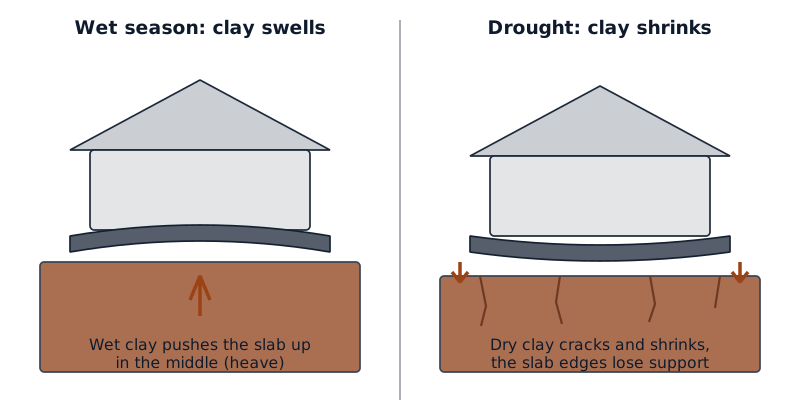
That clay is the reason. The USDA describes the Lake Charles clay found across much of the Houston area as 45 to 60% clay, cracking up to two inches wide in dry spells and swelling again when it rains. An insurer treats that as gradual, predictable movement, not a sudden event. You can find more on this in will home insurance pay for foundation repair, and on the difference between ordinary foundation settling and real failure.
To sum up, from the TDI guide and the ISO form:
| Cause of the damage | Usually covered? |
|---|---|
| Clay soil shrinking and swelling, earth movement | No |
| Settling, cracking from settling, wear and tear | No |
| A continuous or long-running water leak | No |
| Sudden and accidental release of water | Usually yes, for the resulting damage |
| Plumbing leak under the slab that damages the foundation | Only with a foundation endorsement or a policy form that includes it |
| Flood or rising water | No, needs a separate flood policy |
Read your own declarations page and endorsements. Policy forms differ between companies, and the wording in yours is what counts.
When does insurance pay for foundation damage from a slab leak?
Insurance may pay when a plumbing leak causes the foundation damage and your policy has foundation coverage for it. TDI lists damage to foundations or slabs as an optional endorsement many companies offer. One standard Texas form, the Foundation Coverage-Texas endorsement, covers settling and cracking of the slab caused by water leaking from plumbing, heating, air conditioning or sprinkler systems, including tearing out part of the house to reach the pipe.
The fine print matters. Under that endorsement, as TDI approved it, the leaking pipe itself is not covered, only the damage and the tear-out, and the payout is capped at 15% of your Coverage A dwelling amount. Your insurer may use its own version with a different cap. A leak that has run for months is a weaker claim than one you report as soon as you notice it, because TDI notes most policies exclude continuous leaks.
Houston slabs carry water and sewer lines inside or under the concrete, so this is the one route where insurance often comes into foundation work here. For the details, see does homeowners insurance cover slab leak repair and is a slab leak covered by insurance. The warning signs of a slab leak are worth knowing, since reporting early helps the claim.
Does homeowners insurance cover foundation crack repair?
Not when the cracks come from settling or soil movement, which is the cause of nearly all foundation cracks in Houston. A crack is covered only if a covered event caused it, such as a sudden plumbing leak under a foundation endorsement, or a fire. The adjuster looks at the cause, not the crack, so the evidence of cause decides the claim.
Go deeper with does homeowners insurance cover foundation cracks covers how adjusters read crack patterns, and whether home insurance pays for cracks in the foundation covers cracks in walls, brick and drywall that show up with them.
Does flood insurance cover foundation repair?
A flood policy can pay for foundation damage caused directly by flooding, but a standard homeowners policy will not. TDI says most home policies don't cover flood damage. Flood cover is a separate policy, bought from your insurer or through the National Flood Insurance Program, and TDI notes most flood policies have a 30-day waiting period, so it has to be in place before a storm.
Slow clay movement after a wet season is still treated as earth movement, even with a flood policy.
What does a structural engineer report for insurance do?
A structural engineer's report gives the insurer an independent professional opinion on what moved, how much, and why. For a claim, the "why" is the part that counts: it is what separates covered damage, like a plumbing leak washing out soil, from excluded damage, like seasonal clay movement. The insurer may send its own engineer, and your report gives you something to compare against theirs.
A useful report usually includes:
- A floor elevation survey, with readings taken across the slab or floor and drawn as a map.
- Photos and notes on cracks, doors, windows and the outside beam.
- Results of any plumbing test, if a leak is suspected.
- The engineer's conclusion on the cause of the movement.
- A repair scope, such as the number and location of piers, that a contractor can quote against.
Choose an engineer who is independent of the company that will do the repair. You can check a professional engineer's standing on the Texas Board of Professional Engineers and Land Surveyors roster. This Old House puts a structural engineer report at about $500 to $1,000. See how to get a structural engineer report for the steps, and foundation inspection for what a contractor's own inspection covers by comparison.
How do you file an insurance claim for foundation damage?
Tell your insurer as soon as you find the damage. TDI says most companies set deadlines for filing, and some policies allow one year. Photograph or video everything before any repair, make only temporary fixes such as shutting off the water, keep every receipt, and be there when the adjuster inspects, ideally with your contractor or engineer.
In practice: shut off the water if you suspect a leak, photograph cracks with a tape measure in shot, get a claim number, and hold off on permanent repairs. TDI warns that repairing first can lead to a denial.
Texas sets timelines for the insurer once you file. Under TDI's guide, the company must acknowledge your claim within 15 days, accept or deny it within 15 business days of getting the information it needs, and pay within five business days of agreeing to pay. If you disagree with the outcome, TDI lists appraisal, a complaint through its online portal, or court as options. The TDI Help Line is 800-252-3439.
Does a home warranty cover foundation repair?
Usually not. A home warranty, called a residential service contract in Texas, covers mechanical failure of appliances and household systems from normal wear and tear. The Texas Real Estate Commission says these companies now come under the Texas Department of Licensing and Regulation. Foundations are not an appliance or a system, so a standard contract rarely covers them, though some sell add-ons.
If the contract covers plumbing, it may pay for the leaking pipe your homeowners policy leaves out. More detail is in does a home warranty cover foundation repair.
What should you know about buying a house with foundation repairs?
A Houston house with past foundation repairs can be a sound buy if the work was done properly and is documented. Ask the seller for the engineer's report, the repair contract, the pier layout, any permit, and whether a transferable warranty came with the work. Then have your own inspection, because a repair that has held for years is very different from one that is moving again.
Texas law requires sellers of most single-family homes to give a written disclosure of the property's condition, including known defects in structural components and past flooding. Your insurer may also ask about past foundation work when it writes the policy, so have the paperwork ready. Our guide to buying a house with foundation issues walks through the questions, and the foundation repair cost page gives the price ranges to weigh against the asking price.
Questions people ask
Will homeowners insurance pay for foundation repair from settling?
No, in most cases. Settling is listed as an exclusion in the standard Texas HO-3 form, and TDI lists earth movement and wear and tear as risks most policies don't cover. Settling only becomes part of a claim when a covered cause, usually a plumbing leak under the slab, created it and your policy includes foundation coverage. Check your declarations page for a foundation or slab endorsement.
How long does an insurance claim for foundation repair take?
It depends on the insurer and how clear the cause is. Texas rules give the insurer 15 days to acknowledge the claim and 15 business days to accept or deny it once it has what it needs, then five business days to pay. Claims that need a plumbing test and an engineer's report on both sides take longer.
What should I ask before I hire someone for foundation repair on an insurance claim?
Ask whether the quote follows the engineer's repair scope, how many piers it includes and where, and whether a permit is needed. Ask what the written warranty covers and whether it transfers to a buyer. Ask whether they will meet the adjuster on site. Get the price in writing before any work starts, and compare it with the scope the insurer approved.
Do I need to be home for the adjuster's inspection?
Yes, if you can. TDI recommends being there when the adjuster inspects, and having your contractor with you if possible. You can point out every crack, sticking door and floor slope, share your photos and the engineer's report, and hear first-hand what the adjuster thinks caused the damage.
What goes into a structural engineer foundation report?
A typical report has the property details, a floor elevation map with readings, photos of the damage, notes on drainage and trees near the house, any plumbing test results, the engineer's opinion on the cause of movement, and a recommended repair. It is usually signed and sealed by the engineer. An insurer reads the cause section first, since that is what decides coverage.
Read on
- Insurance and foundation repair
Which parts of a slab leak repair a Texas homeowners policy pays for, how the 15% foundation endorsement works, why claims get denied, and…
The rest of our guides start from foundation repair in Houston.
Sources
- Texas Department of Insurance, Home insurance guide
- Texas Department of Insurance, Commissioner's Order 02-0741 on residential policy forms and the Foundation Coverage-Texas endorsement
- Texas Real Estate Commission, Residential Service Companies (Home Warranties)
- Texas Property Code section 5.008, seller's disclosure of property condition
- Texas Board of Professional Engineers and Land Surveyors
- This Old House, foundation repair cost guide (October 2026)
- USDA NRCS, Lake Charles soil series description
Last changed