Uneven floors are rarely dangerous in themselves, but they can be. The everyday risk is a trip or fall over a sudden dip, a lifted tile or a raised threshold. The serious risk is what the slope may be telling you: a floor that is getting worse, feels soft or springy, or comes with fresh cracks and jammed doors can mean the support under the house is failing. A gentle, stable slope in an older home is usually a nuisance, not a hazard. This page sorts the real risks from the cosmetic ones and shows how to judge yours. The repair itself is covered under house leveling.
When are uneven floors actually dangerous?
Uneven floors are dangerous when they cause falls, when they are still moving, or when the framing or piers underneath have lost strength. A floor that sags more each month, bounces underfoot, creaks or cracks under load, or pulls away from the walls needs a professional look soon. A slope that has not changed in years, with square doors and no new cracks, is usually a comfort problem rather than a safety one.
Think of it as three levels of risk:
| What you notice | What it usually means | How urgent |
|---|---|---|
| Gentle slope, unchanged for years, doors close fine | Old settlement that has stopped | Low; watch it |
| A step, lip or lifted tile you catch your foot on | A trip hazard, whatever the cause | Fix the surface soon |
| Slope that grows, new cracks, doors start sticking | The foundation is still moving | Book an inspection |
| Soft, spongy or bouncing floor, or a visible sag | Joists, beams or piers losing support | Keep weight off it and call now |
Houston adds a twist. The Lake Charles clay under much of the area is 45 to 60% clay, the USDA says, and when dry it cracks half an inch to two inches wide and a foot or more deep. That shrink and swell means a floor here can change with the seasons, so one reading tells you less than two taken months apart.
Can uneven floors make you trip and fall?
Yes, and for most households that is the biggest real danger. A sudden change in height catches a toe far more often than a long, gentle slope does. Raised tile edges, a ridge where two rooms meet, a threshold left high after the floor dropped and rugs that slide downhill are the usual culprits. The risk is highest for older adults, small children and anyone walking at night.
The numbers are worth taking seriously. The CDC says more than one in four older adults falls each year, that falls lead to about 4.5 million emergency department visits among older people, and that falls are the most common cause of traumatic brain injuries in that age group. A floor problem is only one cause among many, but it is one you can see and fix.
Until the cause is dealt with, reduce the risk:
- Mark or ramp any step you can't remove, especially at doorways.
- Secure or replace rugs that creep toward the low side of a room.
- Add night lighting along hallways and to the bathroom.
- Replace cracked or lifted tile at the edge, where toes catch.
These are surface fixes. If the floor keeps moving, the lip comes back.
Should you worry about uneven floors that are getting worse?
Yes. A floor that is getting worse means the house is still moving, and movement is what turns a small repair into a large one. Signs include a marble that now rolls where it didn't, doors that start to stick or swing open, new diagonal cracks from door and window corners, and gaps opening at baseboards. Any of these alongside a growing slope is worth an inspection.
On a slab, a worsening slope usually means one edge or corner is dropping as the clay below dries, or heaving after a wet spell. Look outside too. A crack where the driveway meets the garage slab, a gap opening under the bottom row of brick, or soil pulling away from the foundation in summer all point the same way. The fuller list of warning signs is in how to fix uneven floors, which also walks through telling floor problems from foundation problems.
Waiting has a cost. This Old House notes that a hairline crack sealed for $250 to $800 can turn into a $10,000 to $15,000 repair if left alone. In Houston, a typical foundation repair runs about $3,300 to $6,800, according to a 2026 Houston Press guide, so catching movement early matters.
What hidden problems can uneven floors point to?
Uneven floors can point to problems you can't see: a leaking water or sewer line under the slab, strain on gas and water pipes where they enter the house, damp and rot in a crawl space, and windows or doors that would jam in an emergency. None of these is certain, but each is a reason not to dismiss a slope that appeared recently.
- Leaks under the slab. Water from a broken line softens clay unevenly and can make one area drop or rise. A warm spot on the floor, a meter that moves with everything off or a damp patch are clues. See slab leak symptoms.
- Gas lines. Movement can stress rigid piping. If you ever smell gas, the gas utility's own advice is to leave the house on foot with everyone, avoid switches and anything that could spark, and call the utility and 911 once you are safely away.
- Moisture and rot. On a raised floor, sagging often traces back to wet wood. The EPA says mold will not grow without moisture and advises drying water-damaged materials within 24 to 48 hours. Persistent damp under a house weakens joists and sills over time.
- Escape routes. A bedroom window or exterior door that binds because the frame has racked is a fire safety issue. Make sure every bedroom still has a window that opens.
National guides often talk about bowing basement walls as the danger sign. Houston has almost no basements, so here the equivalent signals are a dropping slab edge or a tired pier under a raised floor.
Is it normal for old houses to have uneven floors?
It is common for old houses to have some unevenness, and a stable, gentle slope is usually not dangerous. Wood framing shrinks and creeps over decades, piers settle, and older homes were not built to today's tolerances. What is not normal is change: an old floor that suddenly gets worse, softens or cracks is behaving like a newer one with a problem.
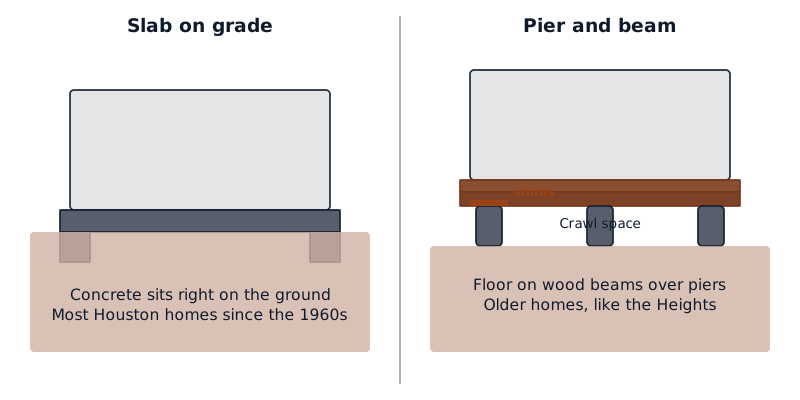
Many Houston Heights bungalows sit on pier and beam, according to the City's design guidelines, and a dip toward the middle of a room or one wall is typical of that construction. The question to ask is not whether the floor is level but whether it is still moving and whether the wood is still strong. The detail for older homes is on is it normal for old houses to have uneven floors.
How do you check how serious your uneven floors are?
You can judge how serious uneven floors are with a few simple checks: measure the slope, note where it changes suddenly, test how the floor feels underfoot, look for matching signs on walls and doors, and repeat the checks a few months later. A slope that stays the same is far less worrying than one that grows. Write everything down with dates and photos.
- Lay a long level or a straight board across each room. Note the direction and whether the drop is gradual or sudden.
- Walk the floor slowly. Bouncing, softness or a hollow feel near one spot matters more than a gentle slope.
- Check doors and windows. Open and close each one and note any that stick, swing or leave a wedge-shaped gap.
- Mark crack ends with a pencil and the date so you can see if they grow.
- Look underneath if you have a crawl space, from the access hatch only. Note any pier that leans, any wet or dark wood, and shims that have crushed.
- Repeat in two to three months, ideally across a dry spell and a wet one.
Stop there. Crawling deep under a sagging floor, or jacking a beam, is where DIY becomes risky. A foundation inspection takes proper elevation readings across the whole house, which tells you far more than a level on one floor.
When should you call a professional about uneven floors?
Call a professional when the floor feels soft or bounces, when you can see a sag from below, when the slope is growing, or when new cracks and sticking doors appear with it. Keep heavy furniture and people off a floor that feels spongy until it has been looked at. For a gentle, stable slope with no other signs, there is no rush.
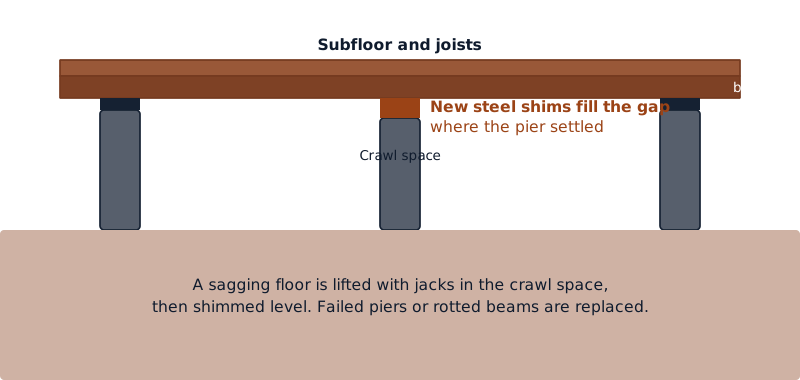
What comes next depends on the cause. A sinking slab usually needs new piers pressed deep to firm soil, strong enough to carry the house. A raised floor may need a pier reset, new shims or work on the framing, covered in sagging floor joist repair. Inside the City of Houston, foundation repair runs under a building permit; the City's weekly permit reports list residential shim and level and block and base repairs. An inspection in Houston averages about $600, with a range of $300 to $1,000, the Houston Press guide says.
We'll arrange a visit from a local foundation contractor, who measures the floor, explains what is moving and why, and sets out the price in writing before any work starts. You can request a quote whenever you're ready.
Questions people ask
Can a floor collapse from uneven floors?
A full collapse is rare in a house, but a local failure can happen when wood has rotted or a support has failed under a raised floor. The warning signs come first: a soft or spongy feel, cracking sounds, a visible sag or a floor that drops noticeably over weeks. If you notice those, keep weight off that area and have it looked at quickly.
Do uneven floors lower a home's value?
They can, mostly because buyers and their inspectors read them as a sign of foundation movement. A stable slope with an explanation, such as an engineer's letter or a record of past repair with readings, worries buyers far less than an unexplained one. Getting the cause measured before you list usually helps more than covering the floor.
Is it safe to live in a house with uneven floors?
In most cases, yes. A house with a gentle, stable slope is generally safe to live in while you plan a repair. Reduce trip hazards at doorways and on stairs. It is a different case if the floor is soft, sagging or getting worse quickly, or if doors and windows are jamming shut. Then treat it as urgent and have the supports checked.
How much slope in a floor is too much?
There is no single number that suits every house, and a reading on one floor is not a diagnosis. What matters more is whether the slope is changing, whether it is sudden or gradual, and whether walls and doors show movement too. A contractor or engineer takes elevation readings across the whole house and compares the high and low points to judge it.
Are uneven floors in a new house dangerous?
Uneven floors in a newer home deserve more attention than the same slope in an old one, because the house has had less time to settle and should be close to level. A slab poured out of level may never move, but one that is changing on Houston clay usually means drainage, a leak or soil movement. Take readings and ask the builder about any warranty paperwork you have.
For the wider picture, start with Foundation Repairs Houston Quotes.
Sources
- CDC, older adult falls facts and statistics
- US EPA, a brief guide to mold, moisture and your home
- CenterPoint Energy, natural gas safety
- USDA NRCS, Lake Charles soil series description
- City of Houston weekly building permit report, July 2024
- Houston Press, guide to foundation repair in Houston (2026)
- This Old House, foundation repair cost guide (October 2026)
Last changed