A piers and beams foundation holds a house up off the ground. Short piers sit on concrete footings, a beam runs across the top of each row of piers, and the floor joists rest on the beams. The open gap underneath is the crawl space. In Houston, pier and beam foundation repair usually means resetting or adding piers, shimming beams back to level, and replacing rotten wood, all done from the crawlspace without breaking concrete. Below: how it works, what goes wrong, the repairs, the costs and keeping the crawl space dry.
What is a pier and beam foundation, and are piers a foundation?
Yes, piers are a foundation. On a pier and beam house, piers of concrete, brick, block or wood stand on concrete footings dug into the soil. Each row of piers carries a beam, and the beams carry the floor joists, as This Old House describes it. Together they pass the weight of the house down to the ground, the same job a slab does, while leaving a crawl space you can get into.
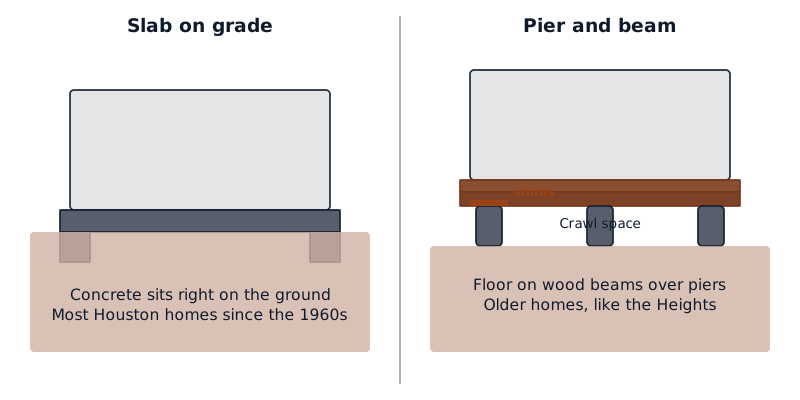
A pier and beam foundation diagram, from the dirt up:
- Footing, concrete in the soil.
- Pier, the post on the footing.
- Beam, timber or steel spanning pier to pier.
- Shims, wedges that set the beam height.
- Joists and subfloor, the floor frame.
- Skirting, which closes off the crawl space.
Most Houston homes built since the 1960s sit on a slab, and very few have a basement. Pier and beam is common in older neighborhoods. The City of Houston's design guidelines for the Houston Heights describe its houses as mostly wood siding on pier-and-beam foundations, with Craftsman bungalows popular from about 1905 to 1925.
What are the downsides of a pier and beam foundation in Houston?
The main downsides are movement and moisture. The piers stand on clay that swells when wet and shrinks in drought, so individual piers rise and sink at different rates. Damp air in the crawlspace can rot sill plates, beams and joists, and invite termites. The result shows up as sagging or bouncy floors, doors that stick, and cracks in drywall or trim.
USDA soil surveys describe Lake Charles clay, common across the region, as 45 to 60% clay that cracks up to 2 inches wide and a foot or more deep when dry. Footings in that soil move with it. And the Department of Energy notes that in humid areas, air coming through crawl space vents is often wetter than the air underneath.
Signs worth a look: floors that dip or slope, a springy floor that often points to sagging floor joists, doors that stick or swing on their own, cracks at window corners, and musty smells or standing water under the house.
How is a pier and beam foundation repaired?
A pier and beam foundation repair starts with a level survey of the floor and an inspection of the crawlspace. Then the fix matches the cause: shimming low beams back to level, replacing cracked or sunken piers, adding piers where spans are too long, sistering or replacing damaged joists and beams, and dealing with the water that caused the damage. Most of the work happens under the house.
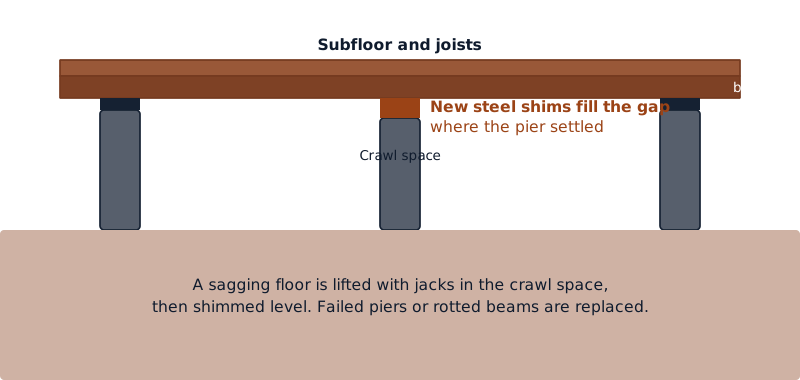
- Reshimming. The beam is jacked slowly to level and solid shims are stacked flat on the pier across the full bearing area. Rotting wood shims or loose stacks often let a floor drop again.
- Pier replacement or added piers. Failed piers are replaced, and extra piers shorten long spans that let the floor bounce.
- Beam and joist repair. Rotted or cracked members are sistered or replaced. If the damage runs through the floor frame, that becomes crawl space structural repair.
- Releveling the house. Raising the whole floor back toward level in stages, covered in detail under house leveling for pier and beam homes.
Jacking a loaded beam is dangerous, and lifting too fast can crack plaster, tile and pipes. The guide to DIY pier and beam foundation repair covers what is safe to try.
When you send an enquiry, we'll arrange a visit from a local foundation contractor who measures the floor, crawls under the house, and gives you a written quote before any work starts.
How much does pier and beam foundation repair cost in Houston?
Most foundation repair jobs in Houston cost about $3,300 to $6,800, according to a 2026 Houston guide. Pier and beam work can land below that for a few shims or well above it when beams and joists need replacing. This Old House notes repair averages are similar across foundation types except pier and beam and stone, so a site visit matters more than a rule of thumb.
| Work | Typical range | Source |
|---|---|---|
| Typical Houston foundation repair job | $3,300 to $6,800 | Houston guide, 2026 |
| Concrete pier, each (Houston) | $300 to $600 | Houston guide, 2026 |
| Steel pier, each (Houston) | $1,000 and up | Houston guide, 2026 |
| Foundation inspection | $300 to $1,000 | Houston guide, 2026 |
| Structural engineer report | $500 to $1,000 | National guide, 2026 |
| Permit | $75 to $150 | National guide, 2026 |
The price turns on the number of piers, how much wood needs replacing, how tight the crawl space is, and whether it needs drainage or encapsulation. The Houston guide adds that access problems raise pier costs by about 6 to 8%. These are guides; the contractor who sees the house quotes the real price. For a full breakdown, see pier and beam foundation repair cost, and for slab and other jobs, the wider foundation repair cost guide.
Is pier and beam cheaper than a slab, and which foundation is strongest?
It depends on the job. A new slab often costs less to build than a raised floor, but pier and beam is usually cheaper and simpler to repair, because a contractor can reach every pier and beam from the crawl space. No foundation type is strongest everywhere: on Houston's shifting clay, the right choice is the one an engineer designs for that lot.
A raised house keeps the floor above surface water and leaves plumbing easy to reach. Deep foundations, such as drilled piers or driven piles, reach firmer soil but need heavy equipment and cost more. That is the main disadvantage of a pile foundation for a house. Our comparison of pier and beam foundation vs slab goes through the trade-offs side by side.
Should you encapsulate or insulate the crawl space under a pier and beam house?
In Houston's humid climate, crawl space encapsulation is often worth considering once the structure is sound. Encapsulation seals the vents, covers the ground with a vapor barrier and insulates the walls instead of the floor. Department of Energy research found unvented, conditioned crawlspaces cut humidity by more than 20% and heating and cooling energy by 15% to 18%.
The Building America Solution Center checklist sets out the work: fix drainage and bulk water first, clear the ground, lay polyethylene at least 6 mil thick over the whole floor and at least 6 inches up the walls, tape the seams, close the vents, insulate the foundation walls and rim joists, and fit an airtight, insulated access door.
With a vented crawl space, insulation between the joists keeps a pier and beam house warm, and vent covers and sound skirting cut drafts. To winterize for Houston's rare hard freezes, cover the vents and wrap exposed pipes. Vinyl, metal and masonry skirting each have trade-offs, set out in our guide to pier and beam house skirting.
Do you need a permit for pier and beam repair in Houston?
Usually, yes. The City of Houston issues building permits for foundation repair, and its weekly permit reports list jobs described as residential shim and level and block and base foundation repairs. The contractor often pulls the permit, but you should ask to see it.
In Bellaire, the city's FY2026 fee schedule lists a $130 floodplain development permit for residential foundation work. In the Houston Heights, three historic districts require a Certificate of Appropriateness for many exterior changes, so new skirting or raising a house there may need review before work starts.
Questions people ask
How much does a foundation cost for a 2000 sq ft house?
Size alone does not set the price of a repair. A 2,000 square foot pier and beam house with a few low spots may only need shims and a handful of piers, which fits within the typical Houston range of about $3,300 to $6,800. Replacing beams and joists across the house, adding drainage or encapsulating the crawl space costs more.
How long does pier and beam foundation repair take?
Many shimming and pier jobs on a pier and beam house take one to a few days, depending on how many piers are involved and how easy the crawl space is to work in. Larger jobs that replace beams, joists or the sill plate take longer. Permits can add time before work begins. The contractor should give you a schedule with the written quote.
What should I ask before I hire someone for pier and beam work?
Ask what is causing the movement and how the repair fixes that cause. Ask what the shims and piers are made of, whether the permit is included, whether an engineer is involved, and what any written warranty covers. Ask for before and after floor level readings, and compare quotes on the same scope.
How is a pier and beam house built?
Footings are poured at set spacings, piers go up on the footings, beams are set on the piers and leveled with shims, then joists, subfloor and walls are framed on top. In Houston, footing depth and pier spacing should come from plans that allow for expansive clay. The crawl space is then closed in with skirting and vents, or encapsulated.
Read on
- DIY pier and beam
Which pier and beam repairs you can do from the crawl space, how to sister a joist and seal ductwork, and where jacking and permits mean a…
- House leveling pier
How a pier and beam house is leveled: the floor survey, the lift sequence, shims and new piers, tight crawl spaces, Houston costs and the…
- Costs
What pier and beam foundation repair costs in Houston: prices per pier, crawl space encapsulation, what pushes a job up or down, and how…
- Pier and beam vs slab
Pier and beam foundation vs slab for Houston homes: a side-by-side table, build and repair costs, post-tension slabs, crawl space care and…
- Pier and beam house skirting
How to choose and fit skirting on a raised Houston house: vinyl, metal, fiber cement, wood or brick, the vents the code asks for, and when…
- Repair crawl space foundation
How to repair a crawl space foundation in the right order: water first, then piers and beams, then vents, vapor barrier, skirting and…
- Sagging floor joist repair
How sagging floor joists are repaired under a raised Houston house: sistering, replacement, a new support beam or blocking, what fits the…
See foundation repair in Houston for the other services and what they cost.
Sources
- This Old House, foundation repair cost guide (October 2026)
- Houston Press, guide to foundation repair in Houston (2026)
- USDA NRCS, Lake Charles soil series description
- US Department of Energy, unvented conditioned crawlspaces (Building America)
- Building America Solution Center, vented to unvented crawl space checklist
- City of Houston weekly building permit report, July 2024
- City of Houston, Houston Heights design guidelines
- City of Bellaire, FY2026 master fee schedule
Last changed