Foundation repair in Baytown starts with one local fact: this ground has already dropped a long way. The USGS records as much as 9 feet of subsidence in the Baytown area between 1906 and 1995, first from oil pumped out of the Goose Creek field and then from groundwater. That sinking has largely stopped, so most cracked slabs here today are caused by soil and water at the lot, not the region. Older faults are the exception. This page sits alongside the Houston areas page and covers what is particular to Baytown.
Why did Baytown sink so much more than most of Houston?
Baytown sank early and deep because two kinds of pumping hit it one after the other. Oil came first: the Goose Creek field near the bay produced millions of barrels from 1918, and the land above it dished downward. Groundwater pumping for ship channel industry followed. By the mid-1970s, the USGS says 6 feet or more had gone along the channel between Baytown and Houston.
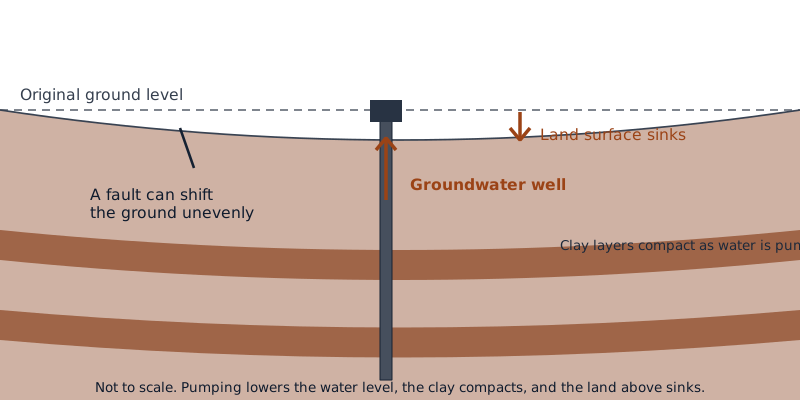
Goose Creek holds a place in the science of subsidence. The USGS calls it the first case of ground sinking from fluid withdrawal described in the scientific literature, and Texas courts accepted that removing oil, gas, water and sand from below caused it. A photograph from about 1926 shows a fissure at Pelley, half a mile north of the oil field, where the ground on one side had dropped about 16 inches.
For a house, that history matters mainly as background. A slab poured in Baytown in the 1950s may sit on land that has since moved several feet as a block. Uniform sinking rarely cracks a house on its own. Uneven movement does.
Is the ground under Baytown still sinking today?
Mostly not. The USGS reports that subsidence has largely been abated in the Baytown area since the late 1970s, after industry switched from wells to surface water piped from Lake Livingston on the Trinity River. Satellite radar studies even suggested 0.4 to 0.8 inches of relative uplift near Baytown, and the Baytown extensometer measured about 0.2 inches of uplift close by.
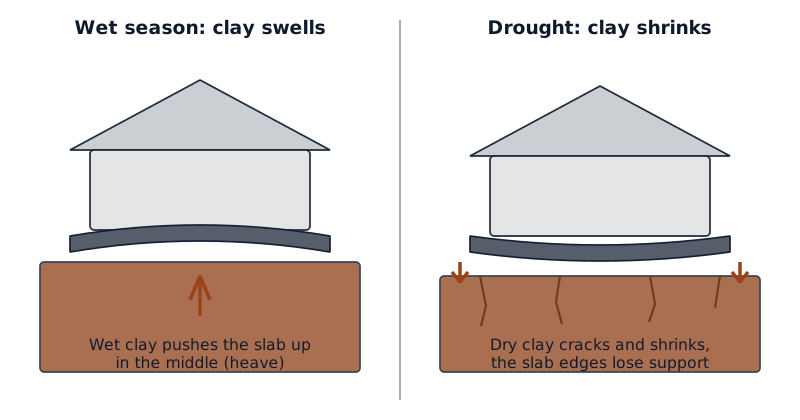
That changes how you read a new crack. If a Baytown house starts showing stair-step cracks in brick or doors that stick, the likely cause is the clay under that slab drying and swelling, a plumbing leak, or water pooling at one side of the house, rather than the whole town settling. A foundation inspection that measures floor levels across the slab is the way to tell which, before anyone prices piers.
Can an old fault line crack a house in Baytown?
Yes, and the USGS has a Baytown example. Its Houston chapter shows a house near the Brownwood subdivision damaged by fault creep. The region has 86 active faults with about 150 miles of scarps, and these scarps have typically grown by up to an inch a year. Fault movement tracks falling water levels, so in eastern areas like Baytown, where water levels recovered from the 1970s, creep stopped or slowed.
A fault crack looks different from ordinary settling. It tends to run in a fairly straight line through the slab, the driveway, the yard and sometimes the street, with one side a little lower. If you see that, tell the person who comes out. Piers can lift and hold a section of house, but they do not stop the ground on either side of a fault moving, so the advice may involve a structural engineer as well as a contractor.
What does the Brownwood subdivision mean for homes near the bay?
Brownwood is the clearest warning in the Houston area of what sinking land plus a storm can do. It was built from 1938 on wooded bay lots generally 10 feet or less above sea level. By 1978 it had sunk more than 8 feet. In 1979, 12 inches of rain flooded 187 homes. In 1983 Hurricane Alicia pushed a storm surge of up to 11 feet across it, and every home was abandoned.
For a house still standing in low parts of Baytown, the lesson is about water more than piers. Land that has dropped holds water longer after heavy rain, and a slab that sits in wet clay for weeks, then dries out, moves more than one with water carried away from it. Before paying to lift a slab, check grading, gutters and where the downspouts empty. Our guide to foundation drainage covers the fixes, and most cost far less than piering.
Do you need a City of Baytown permit for foundation repair?
Inside the city limits, yes. The City of Baytown says the installation, replacement or repair of any structural component of a home needs a residential permit, inside or outside the house, and a foundation is a structural component. Building Services handles these permits. The contractor doing the work usually applies, but it is your house, so ask to see the permit before the first pier goes in.
Baytown sets its own rules, so do not assume a Houston permit or a Pasadena one covers you. If your address is outside the city limits, the city's rule does not apply, so ask the contractor which office covers your lot. A written quote should say who pulls the permit and whether the fee is included.
Questions people ask
How much does foundation repair cost in Baytown?
Most foundation repair jobs in the Houston area, Baytown included, cost about $3,300 to $6,800, according to a 2026 Houston Press guide. Pressed concrete piers run about $300 to $600 each and steel piers start around $1,000. Interior piers and hard access raise the price. Drainage work alone is often cheaper. The foundation repair cost guide breaks the ranges down, and you get a written quote before any work starts.
Should I worry about buying an older house near Brownwood or Goose Creek?
Not automatically, but have the slab measured before you buy. The worst sinking here happened before the late 1970s, and USGS monitoring since then shows little or no further subsidence around Baytown. What you want to rule out is a fault crossing the lot, a slab that has tilted to one side, or poor drainage on low ground. A level survey and a look at the yard and driveway for a straight offset line will show most of it.
Which repair do Baytown slab houses usually need?
Like most of the Houston area, Baytown has many slab-on-grade houses, and the usual fix for a section that has dropped is piers under the edge beam, then lifting the slab back toward level. Our page on slab foundation repair explains the steps. Where the cause is a fault rather than clay or a leak, the repair is different, so the inspection comes first.
Is Baytown sinking the way Katy is?
No. The Harris-Galveston Subsidence District now measures its fastest sinking, over 3 cm a year, out west in the Katy and Fulshear area. Baytown's big drop happened decades ago, and the USGS says it has largely stopped there. Neighboring Pasadena, which sank more than 10 feet, followed the same path once it switched to surface water.
This area guide is part of foundation repair in Houston.
Sources
- USGS Circular 1182, Houston-Galveston chapter (land subsidence, Goose Creek, Brownwood and fault creep)
- USGS Fact Sheet 110-02, subsidence and InSAR monitoring in the Houston-Galveston region
- City of Baytown, when is a residential permit required
- Houston Press, guide to foundation repair in Houston (2026)
Last changed