Most cracks in concrete block walls are shrinkage cracks: block shrinks a little as it dries and cools, and where a wall has no control joints to absorb that, it cracks in a thin vertical line. Those are usually cosmetic. A crack that steps up the mortar joints, runs horizontally, or has one side pushed out past the other points to movement in the ground or pressure behind the wall. In Houston that usually means a block pier, skirting, garage or retaining wall rather than a basement. This page covers how to read each pattern and repair the small ones. For cracks in the slab itself, start with foundation crack repair.
Why do concrete block walls crack?
Concrete block walls crack mainly because they shrink while something holds them still. The Concrete Masonry and Hardscapes Association names drying shrinkage, cooling and carbonation as the causes of that small loss of volume, and says cracks form where the wall is restrained by its footing, floor, roof or corners. Differential settlement of the ground under the wall is the other main cause, and it shows up as stair-step cracks.
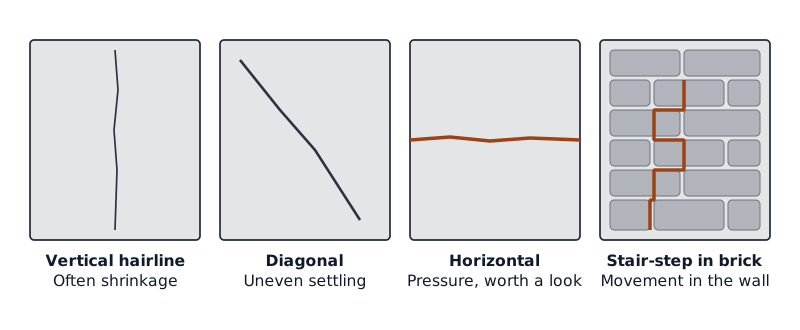
Good design plans where those cracks go, using control joints: vertical breaks built into the wall so each panel can shrink on its own. With control joints and horizontal reinforcement in the mortar beds, the association says cracks stay within about 0.02 inch. Older garden walls, garages and skirting often have neither, so they crack at random.
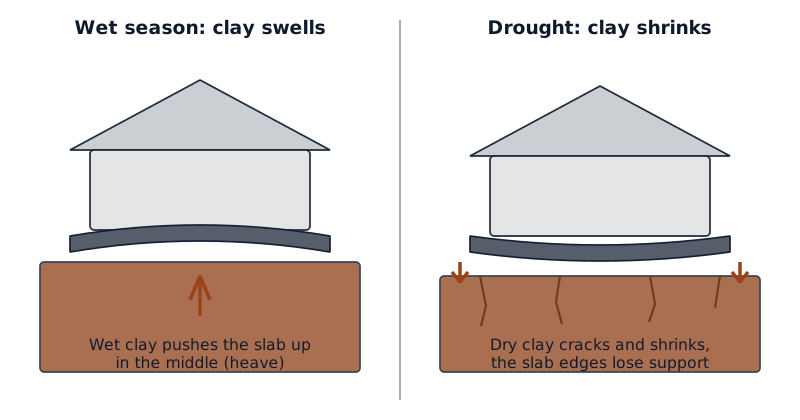
Houston adds its own pressure. The USDA describes Lake Charles clay, common across the area, as 45 to 60% clay that opens cracks 1/2 to 2 inches wide in dry spells. When that soil shrinks and swells under a block wall's footing, the wall rides up and down with it.
Where are concrete block walls on a Houston house?
On a Houston house, concrete block usually turns up below the floor or around the yard, not as a basement wall. Houston has almost no basements, because most homes sit on a concrete slab or on pier and beam. The block you are most likely to see is in the piers and skirting under an older raised house, in a detached garage or workshop, in a garden or retaining wall, or behind stucco on some walls.
- Block piers. Stacked blocks on a concrete base hold up a pier-and-beam house. The city's permit reports list residential "block and base" foundation repairs. A cracked or tilted block pier usually means its base has sunk. See pier and beam foundation repair.
- Skirting and perimeter walls. These carry little load, so cracks here are often shrinkage, or a sign that the beam above has dropped.
- Retaining walls. Soil and water push on one side, which is where horizontal cracks and bowing appear.
Older raised-house neighborhoods like the Houston Heights have more block piers than newer suburbs.
Which cracks in a block wall are serious?
The serious cracks in a block wall are horizontal cracks, cracks with one side offset or bulging, and stair-step cracks that keep widening. This Old House says horizontal cracks are often the most concerning because they point to pressure building outside the wall, and it treats any crack wider than about 1/4 inch as a possible structural sign. Thin vertical cracks that stay the same are usually shrinkage.
| What you see | Likely cause | How serious |
|---|---|---|
| Thin vertical crack, same width top to bottom | Shrinkage, no control joint | Usually cosmetic |
| Crack through the middle of the blocks | Shrinkage or a load on that spot | Watch it |
| Stair-step crack along mortar joints | Settlement under part of the wall | Check the floors and doors inside |
| Crack wider at the top than the bottom | One end of the wall dropping | Needs a look |
| Horizontal crack, wall leaning or bowed | Soil or water pushing from behind | Serious |
| Blocks shifted out of line | Ongoing movement | Serious |
White powdery salt on the block face is efflorescence: a sign of moisture moving through the wall, not of failure.
The direction question is covered in more depth in vertical vs horizontal foundation cracks, and stair-step patterns in masonry are explained in stair-step cracks in brick.
How do you repair cracks in concrete block walls?
You repair a crack in a concrete block wall by first proving it has stopped moving, then cutting out the loose mortar and repointing the joint, or sealing a hairline crack with a flexible masonry sealant. That handles cosmetic cracks and keeps moisture out. It does nothing for a wall that is settling, leaning or being pushed, which needs the cause fixed first.
For a small, stable crack, the usual order is:
- Mark and date the ends in pencil and photograph them beside a ruler. Recheck over a few weeks.
- Rake out loose mortar with a joint raker or a cold chisel, back to sound material. Brush and dampen the joint.
- Repoint with fresh masonry mortar pressed in firmly in layers, then tool it to match the joints around it.
- Seal hairline cracks through the block face with a masonry sealant that stays flexible, since a rigid filler tends to crack again beside the old line.
- Leave control joints alone. They are meant to open. Seal them with a joint sealant, never mortar.
Hydraulic cement works as a quick plug where water is coming through, but This Old House calls it typically cosmetic. The trade-offs are in hydraulic cement for foundation cracks. Injection resins suit solid concrete better than hollow block, so ask a contractor before trying one of the kits covered in epoxy injection for foundation cracks.
Is a cinder block foundation crack different from a slab crack?
Yes. A crack in a cinder block foundation or pier usually follows the mortar joints, because the joints are the weakest part, while a slab cracks straight through solid concrete. Block also has hollow cores, so water that gets into a crack can travel inside the wall. The causes overlap, though: shrinkage and soil movement crack both, and the way to tell harmless from serious is the same.
In everyday speech, cinder block, cement block and concrete block mean the same thing on a house. Under a cracked block pier, check the rooms above for soft spots, sloping floors and sticking doors.
When does a cracked block wall need a contractor?
A cracked block wall needs a contractor when the crack is wider than about 1/4 inch, keeps growing past your pencil marks, runs horizontally, or comes with a lean, a bulge, sagging floors or sticking doors. At that point the crack is a symptom. The fix is under the wall or behind it: piers, a reset footing, drainage, or bracing for a retaining wall.
This Old House says sealing a crack won't solve it if moisture and pressure aren't dealt with at the source. For a leaning wall, it lists carbon fiber straps or wall anchors, usually alongside drainage or soil work. Water standing against a wall is the most common trigger here, so foundation drainage is often part of the job.
Inside the City of Houston, foundation repair runs under a building permit, including shim and level work on block and base foundations. Patching a mortar joint is not foundation repair; resetting piers or rebuilding a structural wall is, and the contractor pulls that permit.
What does block wall crack repair cost in Houston?
Sealing or filling a single crack typically costs about $250 to $800, based on a national 2026 cost guide. If the cracks come from a settling pier or footing, the job becomes foundation work: a Houston guide puts concrete piers at about $300 to $600 each and most Houston foundation repairs at about $3,300 to $6,800. An inspection runs about $300 to $1,000.
These are guides, not quotes; the contractor prices the real job. More detail is in foundation crack repair cost. We'll arrange a visit from a local foundation contractor, with a written quote before work starts.
Questions people ask
Are hairline cracks in a concrete block wall normal?
Yes, hairline cracks in concrete block are common and usually come from the block shrinking as it dries and cools. The Concrete Masonry and Hardscapes Association says that even a well-built wall with control joints and reinforcement is designed to keep cracks to about 0.02 inch, not to prevent them. If they don't grow over a few weeks, seal them to keep moisture out.
Can you waterproof a cracked block wall?
You can slow water down, but only after the cracks are repaired and the cause is known. A masonry water repellent or coating helps on a wall with fine, stable cracks. It won't hold on a wall that is still moving. Most water problems on Houston block walls start with wet soil outside, so fix grading and drainage first.
Should I fill a control joint that has opened up?
No, not with mortar. A control joint is a vertical break built into the wall on purpose so the block can shrink without cracking elsewhere. If you pack it with mortar, the wall loses that relief and cracks somewhere new. Clean the joint and refill it with a flexible joint sealant.
Can a cracked block retaining wall be repaired?
Often, yes. A retaining wall with fine vertical cracks can be repointed and sealed. One with a horizontal crack, a lean or a bulge is being pushed by soil and water, and patching won't hold. It usually needs drainage behind it and bracing or a partial rebuild. Have it looked at before it moves further.
Does moisture make concrete block walls crack?
Moisture plays a part in two ways. Block shrinks as it dries, which causes many vertical cracks. More importantly in Houston, wet clay soil swells and dry clay shrinks, moving the footing under the wall. Water trapped behind a retaining wall also adds pressure.
For the wider picture, start with Houston foundation repair.
Sources
- Concrete Masonry and Hardscapes Association, Crack Control Strategies for Concrete Masonry Construction (CMU-TEC-009)
- This Old House, foundation cracks: what is normal and when to worry (2026)
- This Old House, foundation repair cost guide (October 2026)
- Houston Press, guide to foundation repair in Houston (2026)
- USDA NRCS, Lake Charles soil series description
- City of Houston weekly building permit report, July 2024
Last changed