Most cracks in concrete walls are thin shrinkage cracks that formed as the concrete dried, and they are cosmetic. The ones that matter are wider than about 1/4 inch, run horizontally, leave one side sticking out past the other, or keep growing. On a Houston house the concrete wall is rarely a basement wall. It is the exposed face of the slab, a garage stem wall or a retaining wall in the yard. This page covers how to read a crack in poured concrete, which filler suits it and how to fill it yourself. For the full range of repairs, start with foundation crack repair in Houston.
Are cracks in concrete walls normal?
Some are. Concrete shrinks as it dries and cools, and when something holds it in place, it cracks to relieve the strain. The American Concrete Institute lists drying shrinkage, thermal movement, settlement, missing control joints, overload and restraint as the usual causes. Hairline cracks from shrinkage are expected in almost any poured wall and are typically cosmetic. Cracks from settlement or pressure are the ones to watch.
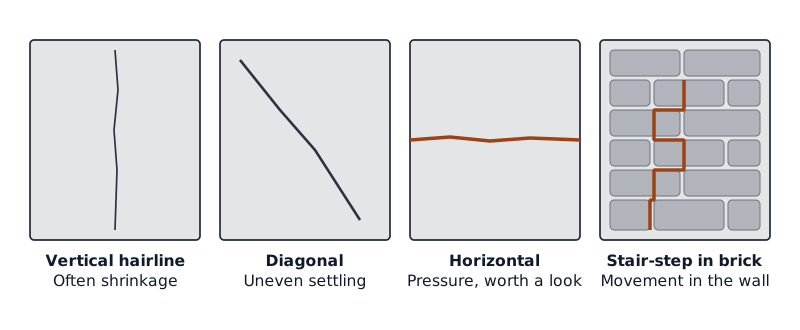
A shrinkage crack often runs roughly vertical, is about as even in width end to end, and stays the same size. This Old House quotes a mason: a crack that appears suddenly, or keeps growing, isn't normal. So the real question is whether it is still moving.
Which concrete walls crack on a Houston home without a basement?
Most advice online is written for basement walls, which hold back soil and groundwater. Houston homes almost never have a basement. They sit on a slab or on piers and beams, so the concrete walls you can see are short and crack for different reasons.
- The slab edge. The outside face of the perimeter beam, the band of concrete showing between the soil and the siding or brick, is the concrete wall most Houston owners find cracked. Repairs from outside are covered on fixing cracks in foundation on the outside.
- Garage stem walls and curbs. These often crack at corners.
- Retaining walls. Poured walls along a slope or driveway cut carry soil pressure and act most like a basement wall.
- Concrete block. Blocks crack along mortar joints; see cracks in concrete block walls.
How can you tell if a crack in a concrete wall is serious?
A crack is serious when it is wider than about 1/4 inch, wider at one end than the other, offset so one face sits proud of the other, running horizontally along a wall that holds back soil, stained with rust, or growing over weeks. Any of those points to movement or damage behind the concrete, not shrinkage. A single thin, even, vertical crack that stays put is usually cosmetic.
| What you see | What it usually means | What to do |
|---|---|---|
| Thin vertical crack, even width, not growing | Drying shrinkage | Seal it to keep water out |
| Crack wider at the top or bottom | Part of the wall or slab has settled or lifted | Mark it, then have it looked at |
| Horizontal crack in a retaining wall | Soil pressure pushing the wall | Do not fill it and leave it; get advice |
| One side offset from the other | Shear movement | Professional assessment |
| Rust stain bleeding from the crack | Steel inside is corroding | Professional repair, not a filler |
The ACI bulletin warns that cracks from corroding reinforcing steel should not be epoxy injected, because the corrosion keeps opening new ones. Crack direction is covered in depth on vertical vs horizontal foundation cracks.
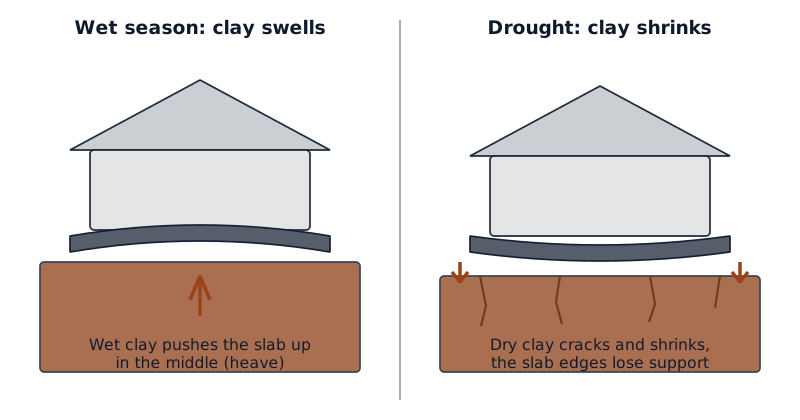
To check movement, mark each end in pencil with the date and photograph it beside a ruler, then look again after a few weeks and after the weather turns. Houston's Lake Charles clay opens cracks 1/2 to 2 inches wide in the ground as it dries, says the USDA, so a slab-edge crack that widens in late summer means the soil is moving.
What should you use for filling cracks in concrete walls?
Match the filler to the crack. A stable hairline or narrow crack that only needs keeping dry takes a flexible polyurethane or concrete sealant. A dormant crack in a wall that needs its strength back takes injected epoxy. A crack that is actively leaking takes a polyurethane injection or a fast-setting plug. A crack that is still moving should not be filled rigidly at all until the cause is fixed.
| Filler | Best for | Limit |
|---|---|---|
| Flexible concrete sealant (polyurethane caulk) | Stable cracks up to about 1/4 inch on a slab edge or garage wall | Seals the surface only; no strength |
| Epoxy injection | Dormant structural cracks that need bonding | Rigid; the ACI says it may not suit a crack that will move again |
| Polyurethane injection | Cracks that leak or don't need structural repair | Flexible, but adds no strength |
| Hydraulic cement | Plugging a crack that is wet or seeping | A plug, not a repair; see hydraulic cement for foundation cracks |
The ACI bulletin says epoxy injection can restore strength in cracks as narrow as 0.002 inch, once the cause is corrected, and favors polyurethane grouts where the crack isn't structural. The process is set out on epoxy injection for foundation cracks.
How do you repair cracks in concrete walls yourself?
You can seal a stable, narrow, non-structural crack yourself in an afternoon: clean it out, let it dry, fill it with a flexible sealant made for concrete, and tool it smooth. Stop before you start if the crack is wide, offset, horizontal in a retaining wall, rusty or still moving. A sealed crack keeps moisture out; it does not fix whatever opened it.
- Confirm it's stable. Watch your pencil marks for a few weeks. If it has grown, don't fill it.
- Clean the crack. Wire brush about 1/2 inch either side, as the ACI bulletin advises, then vacuum out the dust.
- Let it dry. Most sealants need dry concrete. After rain or hosing, give it a dry day or two.
- Add backer rod in deep cracks. For a deep crack, press in foam backer rod so the sealant doesn't sink.
- Fill and tool it. Run the sealant along the crack, overfill slightly, and smooth it flush with a putty knife or a gloved finger.
- Keep watching. Leave your pencil marks visible beside the repair. If the sealant tears within a season, the wall is still moving.
On a slab edge, also fix what made the crack: downspouts dumping water against the beam, or bare clay that bakes and shrinks in August.
Why do concrete retaining walls crack, and can you fix them?
A retaining wall cracks because soil and trapped water push on it from one side. When the drainage behind it clogs, water pressure builds on top of the soil pressure, and the wall cracks horizontally, leans or bows. You can seal a thin vertical shrinkage crack in a retaining wall, but a horizontal crack, a lean or a bulge needs the drainage and the wall looked at.
Check that any weep holes or drain outlets along the base run after rain. If they are blocked, filling the crack traps more water behind the wall. A wall holding back a tall bank, or one beside a driveway or the house, is a job for a contractor and often an engineer.
When do cracks in concrete walls need a foundation contractor?
Call a foundation contractor when the crack is wider than about 1/4 inch, offset, rusty, horizontal in a wall that retains soil, or growing, or when it comes with doors that stick, gaps around windows or a sloping floor. Those signs mean the slab or wall is moving, and that is a repair to the support under it, not to the crack.
Inside the City of Houston, foundation repair needs a building permit, and cities outside it have their own rules. This Old House puts professional crack filling at about $250 to $800 nationally, with permits adding $75 to $150. Houston figures for larger repairs are on foundation crack repair cost.
When you ask for an estimate, we'll arrange a visit from a local foundation contractor. They look at the crack and the wall, check the slab for movement, explain whether it needs a sealant, an injection or support underneath, and give you the price in writing before any work starts.
Questions people ask
Are cracks in cement walls the same as cracks in concrete walls?
Usually people mean the same thing, because cement is the binder that makes concrete set. A poured concrete wall cracks and is repaired as this page describes. If your "cement wall" is stucco on a framed house, that is a thin cement plaster finish, and its cracks often start in the plaster or the framing behind it. Stucco cracks can still reflect foundation movement, so check the slab too.
Does a sealed crack in a concrete wall need waterproofing?
Not usually on a Houston slab edge or garage wall, since there is no basement behind it to keep dry. Sealing the crack and moving water away from the concrete does the job. A retaining wall is different: waterproofing on the soil side and working drainage keep pressure off it. A wall that seeps through many cracks needs its drainage fixed before any coating.
Why does a crack in a concrete wall keep coming back after you fill it?
Because the cause is still there. A rigid filler in a crack that opens and closes with the seasons breaks loose, and a flexible sealant can tear. In Houston the usual culprit is clay soil drying and swelling under the slab edge. If a repair fails within a year, have the foundation checked before filling it again.
Can moisture get into a house through a cracked concrete wall?
It can. On a slab home, water entering through a crack in the perimeter beam can soak the clay under the edge of the slab, and wet clay swells. That is why even a cosmetic crack on the outside face of the slab is worth sealing, and why gutters and grading matter as much as the filler.
For the wider picture, start with Houston foundation repair.
Sources
- American Concrete Institute, Structural Crack Repair by Epoxy Injection (ACI RAP Bulletin 1)
- This Old House, foundation cracks: what is normal and when to worry (2026)
- This Old House, foundation repair cost guide (October 2026)
- USDA NRCS, Lake Charles soil series description
- City of Houston weekly building permit report, July 2024
Last changed