An acceptable crack in a concrete slab is one that stays under the published thresholds and stays still. The building industry's own yardstick, the National Association of Home Builders (NAHB) performance guidelines, treats a floor slab crack wider than 3/16 inch as the point where it counts as a defect. An engineering scale NAHB cites classes hairline cracks up to 1/8 inch as negligible to slight. Width is only half the test: a crack with one edge higher than the other, or one that keeps growing, fails at any size. Below are those numbers, how to measure your crack, and what to do with one that passes. For the repair side, start with foundation crack repair in Houston.
What size crack in a concrete slab is acceptable?
A slab crack under 3/16 inch wide with no height difference between its two sides is generally treated as acceptable. That is the NAHB's floor slab threshold, used by third-party new-home warranties as a construction performance standard. On the engineering scale NAHB also cites, hairline to 1/8 inch is negligible to slight, 3/16 to 9/16 inch is moderate, 9/16 to 1 inch is severe, and anything over 1 inch is very severe.
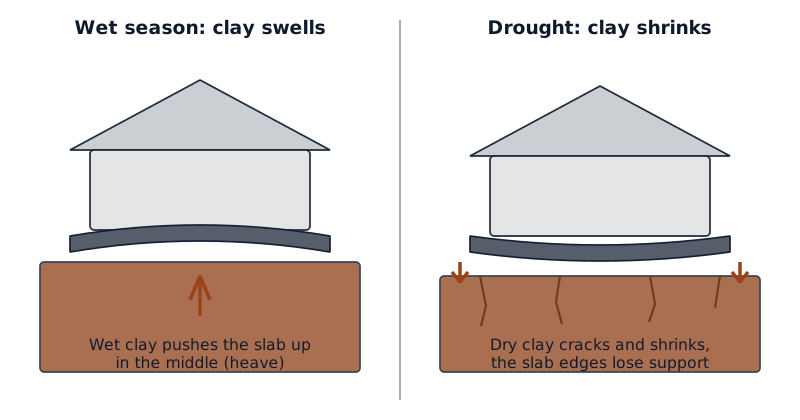
Here is how the published numbers line up, with what each band usually means for a house on a slab:
| Crack width in the slab | Engineering class | What it usually means |
|---|---|---|
| Hairline to 1/8 inch | Negligible to slight | Shrinkage. Acceptable if flat and stable |
| 1/8 to 3/16 inch | Between the bands | Acceptable on most warranty standards; worth monitoring |
| 3/16 to 9/16 inch | Moderate | Over the builder threshold; have it assessed |
| 9/16 to 1 inch | Severe | Likely movement; needs an assessment before repair |
| Over 1 inch | Very severe | Structural evaluation needed |
These are guides, not laws. NAHB itself notes there is no universal standard for judging cracks, so a warranty or an engineer's report should name the yardstick it uses.
Is it normal for a new concrete slab to crack?
Yes. Concrete shrinks as it dries, and the American Concrete Institute says cracking should be expected unless the air around the concrete is kept near 100% humidity. Its slab guides go further: crack-free floors are unrealistic even with good design and workmanship, and some cracking is normal on every project. Most of those are fine hairline cracks that appear in the first months and then stop.
ACI also notes that concrete can take years to finish shrinking. What separates a normal shrinkage crack from a movement crack is behavior: shrinkage cracks stay narrow, stay flat and stop growing. If you want to see the common shapes, our guide to pictures of normal foundation cracks shows them side by side, and why concrete slabs crack covers the causes.
Which slab cracks are not acceptable, whatever their width?
A crack with vertical displacement is not acceptable even if it is narrow. That means one side of the crack sits higher than the other, which you can feel by running a fingertip across it. NAHB lists cracks with vertical displacement as a sign of a potential structural problem, alongside large separations, sloping floors, doors and windows that stop working, and walls that bow or lean.
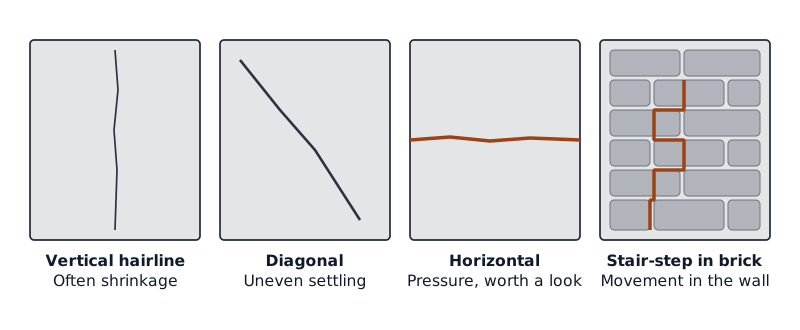
Other cracks that fail the test regardless of width:
- A crack that is growing. A 1/16 inch crack that was a hairline last spring is moving. Width today matters less than the trend.
- A crack that lines up with damage above it. A slab crack under a doorway that has started to stick, or under a stair-step crack in the brick, suggests the slab is bending.
- A crack with moisture coming through. Water or damp at a slab crack points to a leak or to groundwater, and it needs finding before anything is sealed.
Horizontal cracks are the classic warning on a basement wall in colder parts of the country. Houston homes almost never have a basement, so here the direction of a crack in the slab surface matters less than its offset and its trend. Our guide to vertical vs horizontal foundation cracks covers direction in the walls.
How do you measure a slab crack yourself?
Measure the widest point with a crack width gauge, a clear plastic card printed with lines of known width that you lay over the crack until one matches. Write the width and date on the slab beside the crack in pencil or marker, mark both ends, and photograph it with a ruler in the frame. Repeat every month or two through at least one dry summer and one wet season.
A simple routine:
- Find the widest point and measure it with the gauge. Note it in inches.
- Check for offset. Lay a straightedge across the crack. Any gap under one side is vertical displacement; measure it too.
- Mark the ends with a short line and the date.
- Photograph square to the floor with a ruler beside the crack, from the same spot each time.
- Compare after each season. A crack that is the same width in August and February is behaving.
Seasonal timing matters on Houston clay. The USDA describes Lake Charles clay, common across the area, as 45 to 60% clay that cracks open 1/2 to 2 inches wide at the surface when dry. That wet and dry swing moves slabs, so a crack can widen in a drought and close again after rain. Measure through both before deciding it is stable.
What counts as acceptable under a Texas builder warranty?
For a newer Texas home, acceptable is usually defined in the builder's warranty. NAHB quotes the Texas Association of Builders' structural defect definition: overall slab deflection no greater than its length divided by 360 (L/360), with no more than one related sign of distress, and no tilt over 1% across any overall dimension. A crack alone, under those terms, rarely qualifies.
To put L/360 in numbers: across a 40 foot slab, 480 inches divided by 360 allows about 1 1/3 inches of deflection. A 1% tilt across a 50 foot house is 6 inches. So a warranty claim normally rests on a floor elevation survey, not on crack width. NAHB also notes that slab-on-grade foundations can be designed to move up to 4.5 inches, so some movement is part of the design.
Definitions vary between warranty providers, so read the exact wording in your own documents. How to get a structural engineer report explains what that report contains.
Should you seal a crack that is acceptable?
Usually yes, if it is open at the surface. An acceptable crack is not a structural concern, but it is still a path for moisture to reach flooring and for grit and water to work into the edges. Sealing a stable hairline crack with a flexible sealant or a low-viscosity filler is cheap, and This Old House puts professional crack filling at about $250 to $800.
Seal only after a few months of measurements show the crack is stable, because sealant hides the evidence.
A homeowner can fill a stable hairline crack in a garage floor. Once a crack is moving, offset or letting water in, the fix is under the slab, not in it, and the work is for a professional. In the City of Houston, foundation repair needs a building permit; the city's weekly permit reports list them by the dozen. The epoxy injection guide covers what professional sealing involves and where it fails.
When should a slab crack be looked at by a professional?
Get a professional to look when a crack is wider than 3/16 inch, has any vertical offset, is growing between your measurements, lets water through, or comes with sticking doors, sloping floors or brick cracks. An inspection gives you a cause and a written scope. A serious crack is a symptom, and the repair has to deal with what is moving the slab.
Questions people ask
Is a 1/8 inch crack in a concrete slab acceptable?
Usually, yes. A 1/8 inch crack sits at the top of the negligible to slight band on the engineering scale NAHB cites, and below the 3/16 inch floor slab threshold used by new-home warranties. It is acceptable if both edges are level and it is not growing. Measure it again after a dry spell and after heavy rain before you treat it as settled.
Are hairline cracks in a garage slab normal?
Yes. A garage slab dries and shrinks like any other concrete, and with no flooring over it, every shrinkage hairline is on show. The American Concrete Institute treats some cracking as normal on every slab project. A hairline that stays narrow and flat needs nothing more than an optional sealant to keep water and grit out.
Can a crack be acceptable and still let water in?
It can be acceptable structurally and still be worth fixing for moisture. A stable crack can wick groundwater or let water from a leaking pipe show at the surface. Find the source first: a plumbing leak under the slab is a different problem from rain soaking the edge. Waterproofing a crack without finding the water source usually fails.
Who decides if a crack in my slab is acceptable?
For a newer home under warranty, the warranty document decides, and an engineer usually measures against it. For an older home, it is a judgment by an inspector, a structural engineer or a foundation contractor, using width, offset, trend and the condition of the house above. Ask whoever inspects to state the yardstick they used in writing.
Does a crack under 3/16 inch ever need foundation crack repair?
Sometimes. If a narrow crack has an offset, keeps widening, or sits under a sticking door or cracked brick, it can be the first sign of movement, and the repair may involve piers rather than a filler. Width is a screening tool, not a verdict. The trend over a few months is what tells you which you have.
For the wider picture, start with foundation repair across Houston.
Sources
- National Association of Home Builders, Misconceptions About the Common Crack (Construction Liability and Risk Management Committee, January 2018)
- American Concrete Institute, ACI 224R-01 Control of Cracking in Concrete Structures, chapter 3
- American Concrete Institute, technical FAQ on acceptable crack widths
- This Old House, foundation repair cost guide (October 2026)
- USDA NRCS, Lake Charles soil series description
- City of Houston weekly building permit report, July 2024
Last changed