Corner cracks in walls are usually stress showing up at the weakest point. Every door, window and wall junction is a corner where movement concentrates, so that is where cracks appear first. A short, fine crack from the top corner of one door is most often framing lumber shrinking. Diagonal cracks from several openings on the same side of the house, or a corner crack that keeps widening, more often mean the slab or piers have moved. This page shows how to tell the corners apart, how to measure and track one, and how to fix it so it stays fixed. Wall cracks of every shape are compared on our foundation crack repair hub.
Why do cracks start at the corners of doors and windows?
Cracks start at door and window corners because an opening breaks the wall into a weaker section, and the stress from any movement gathers at its sharp corners. The header above the opening also shrinks as it dries. When the slab moves, or the framing shrinks, the wallboard splits at the corner first and the crack runs off at an angle, usually upward from the top corner or downward from the bottom one.
Two things load those corners. The first is the wood itself. The National Research Council Canada describes how headers over doors and windows shrink away from the studs that hold them up, which opens gaps right at the corners. Wide solid lumber headers shrink more than engineered ones, so older and custom homes often show it more.
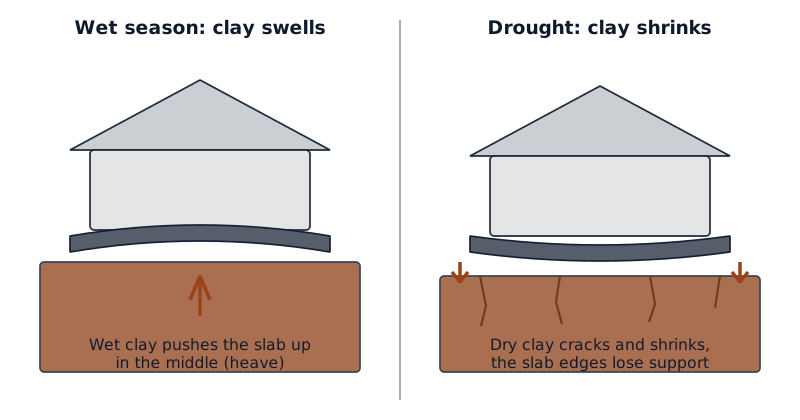
The second is the ground. Much of the Houston area sits on clay that swells when wet and shrinks when dry. The USDA describes Lake Charles clay as 45 to 60% clay, with surface cracks 1/2 to 2 inches wide when dry that stay open 60 to 90 days in most years. When one side of a slab dries and drops more than the other, the openings on that side rack out of square, and the corners crack.
Which kind of corner crack do you have?
There are four corners where cracks show up in a house, and each points to a different cause. Door and window corners point to framing shrinkage or foundation movement. Inside corners, where two walls meet, usually mean uneven framing shrinkage. The corner where wall meets ceiling is usually roof framing. Exterior brick corners near the ends of the house are the ones most tied to the slab.
| Where the corner crack is | Most likely cause | How worried to be |
|---|---|---|
| Top corner of one door or window, hairline | Header lumber shrinking | Low. Tape and watch |
| Several door and window corners on one side | Slab or piers settling or heaving | Higher. Have it checked |
| Vertical crack down an inside corner | Corner studs shrinking unevenly | Low |
| Gap where wall meets ceiling | Roof trusses lifting | Low, but it comes back |
| Brick at an outside corner of the house | Corner of the slab dropping | Higher. Have it checked |
Inside wall corners crack along the tape line when one side of a three-stud corner shrinks more than the other. The Building Science Corporation recommends two-stud corners, or leaving the wallboard loose on one side, so the tape carries the joint instead of fighting the wood. Ceiling corners open when roof trusses arch upward because their top and bottom chords hold different amounts of moisture. Neither of these points to the foundation on its own.
What does the angle of a corner crack tell you?
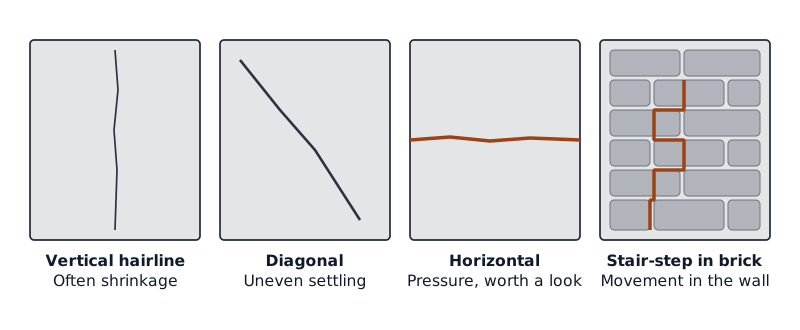
The angle of a diagonal corner crack often points toward the movement. A crack that slopes up and away from a door corner usually means the wall on the lower side of the crack has dropped relative to the other side. A crack that is wider at one end than the other suggests part of the wall is rotating rather than simply shrinking. Straight, even hairline cracks are far more likely to be lumber than soil.
Read the crack with the door. If the top corner crack runs up toward the hinge side and the door now rubs at the latch side top, that side of the frame has likely dropped. Our page on doors sticking explains how to read the gaps around a door. Then walk outside to the same wall. A corner crack inside that lines up with a stair-step crack in the brick outside is a stronger sign than either crack alone; see stair-step cracks in brick.
Horizontal cracks are a different case. In a Houston home without a basement, a horizontal crack at a corner is usually a wallboard seam or the ceiling line. A horizontal crack in a structural wall, or one that bows, is serious and needs a professional look.
How do you measure and track a corner crack?
Measure a corner crack at its widest point, mark both ends with a pencil and the date, and check it every month for at least a few months, ideally through a dry summer and a wet spell. A crack that holds its length and width is old movement. One that grows past your marks, or opens and closes with the seasons, means the house is still moving and patching it now will fail.
- Measure the width. Use a crack gauge, a feeler gauge or a ruler with 1/32-inch marks. Note the widest point.
- Mark the ends. Draw a short pencil line across each tip and write the date beside it.
- Photograph it. Hold a ruler or coin beside the crack so each photo has a scale.
- Check every corner on that side. Note every opening that has a crack, and whether doors and windows still close evenly.
- Repeat monthly. Compare the width, the length past your marks and the photos.
For scale, the BRE crack classification used by building surveyors treats cracks up to about 5 mm (just under 3/16 inch) as aesthetic damage that needs only redecoration, with wider cracks moving into damage that affects doors, windows and weather-tightness. The BRE also notes that whether a crack is growing can change its category. Width alone is not the whole story; growth matters more.
How do you fix a corner crack so it does not come back?
Fix a corner crack only after you know it has stopped moving, and use a method that can flex. Cut out loose tape, fill and tape the crack, and feather the compound wide. At door and window corners, run the tape across the corner rather than along the crack. At ceiling corners, let the joint float instead of filling it rigidly. A rigid patch over a moving corner will simply crack again.
For a fine crack at the corner of an opening, open the crack slightly with a utility knife, fill it, embed mesh or paper tape, then apply two or three thin coats wider each time. Our guide to filler for cracks in walls compares the fillers and tapes.
For a wall to ceiling corner, the Building Science Corporation advice is to keep ceiling fasteners more than 18 inches back from the top of interior partition walls and use clips so the corner can float. That is a framing change, but it explains why a filled ceiling corner reopens every year. A trim strip fixed only to the ceiling can hide the gap.
If the crack sits in plaster walls on an older pier and beam house, check that the plaster around it is still tight to the lath before you patch.
When is a corner crack a foundation problem?
A corner crack is likely a foundation problem when it grows month after month, appears at several openings on one side of the house, comes back soon after a repair, or arrives with doors that stick, floors that slope and brick cracks outside. A single fine crack at one door that stays the same is usually not. When the signs stack up, have the foundation looked at before you spend money on patching.
Moisture is often the trigger. A dry spell shrinks the clay under one edge of the slab, and a wet spell swells it again, so corner cracks in Houston often widen in late summer and close a little after rain. The Arizona Geological Survey lists jammed doors and windows and cracked walls among the usual signs of shrinking and swelling clay. Steady watering along the slab edge and gutters that drain away from the house reduce the swing. Waterproofing a wall surface does nothing for this kind of movement.
Some areas add ground movement of their own. Parts of the region, such as Katy, still record measurable subsidence each year. A local foundation contractor or a structural engineer can measure the floor levels and tell you whether the slab has moved.
What does it cost to deal with corner cracks?
Most corner cracks cost nothing but your time and a little filler. When a foundation check is warranted, a Houston foundation inspection averages about $600, within a range of about $300 to $1,000. Sealing a single crack runs about $250 to $800 nationally. If the slab needs piers or leveling, the price depends on the number of piers and access, so get a written quote after a visit.
The City of Houston requires a building permit for foundation repair. A contractor doing slab or pier work inside city limits should apply for it, so ask about it on the quote. Inside Bellaire and other separate cities, check with that city's building department. Plain wallboard patching does not touch the foundation.
Questions people ask
Are corner cracks in walls normal in a new house?
Often, yes. New framing lumber keeps drying for the first year or two, and headers over doors and windows shrink away from the studs beside them. That leaves fine cracks at the top corners of openings in many new homes. Tape and patch them once, after the first full year, and watch whether they return. Cracks that keep widening after that point deserve a closer look.
Why does the crack at my door corner keep coming back?
A corner crack that returns after a patch usually means the wall is still moving, either from seasonal clay movement under the slab or from framing that was never allowed to flex. A rigid filler over a moving corner will crack along the same line. Track the width for a few months before the next repair, and use tape across the corner rather than filler alone.
Should I worry about a crack in the corner where two walls meet?
Usually not. A straight vertical crack down an inside corner is most often the studs at that corner shrinking unevenly, which splits the tape line. It is worth a closer look if the corner also shows a gap that is wider at the top than the bottom, if nearby doors stick, or if the crack keeps growing over several months.
Do hairline cracks at window corners need a professional?
Most hairline cracks at window corners do not. If the crack is fine, even in width and stays the same over a few months, it is almost always shrinkage, and you can patch it yourself. Call a professional when several windows on one wall crack together, the windows start to bind, or the brick outside that wall has cracked as well.
Do corner cracks mean water is getting into the house?
Interior corner cracks in wallboard do not let water in on their own. Cracks in exterior brick or siding at an outside corner can, so seal them once you know they have stopped moving. Moisture in the soil is more often the cause of corner cracks than their result, because wet and dry spells move the clay under the slab.
This guide is one of many on the foundation repair guide for Houston.
Sources
- National Research Council Canada, Canadian Building Digest 244, Effects of Wood Shrinkage in Buildings
- Building Science Corporation, RR-0107 Drywall, Wood and Truss Uplift
- BRE Group, assessing cracks in houses (summary of BRE Digest 251)
- Arizona Geological Survey, problem soils
- USDA NRCS, Lake Charles soil series description
- This Old House, foundation repair cost guide (October 2026)
- Houston Press, guide to foundation repair in Houston (2026)
- City of Houston weekly building permit report, July 2024
Last changed