Doors stick for three main reasons: the wood has swollen with moisture, the hinges or hardware have worked loose, or the frame has been pulled out of square because the house has moved. In Houston the first and last are both common. Humid air makes wood doors swell, and the clay under most homes shrinks and swells with the seasons, which can twist a slab or a pier-and-beam floor just enough to bind a door. This page shows you how to tell which one you have, what you can fix in an afternoon, and when sticking doors are one of the signs of foundation problems worth having checked.
Why are my doors sticking?
Most sticking doors in Houston come down to moisture, hardware or movement. Wood is hygroscopic, which means it takes on water from the air and swells, so a door that sticks only in humid months is usually just damp. A door that sags at the latch side often has a loose top hinge. A door that sticks all year, with a wedge-shaped gap above it, points to a frame pushed out of square.
| What you see | Most likely cause | First thing to try |
|---|---|---|
| Sticks in humid months, fine in dry ones | Wood swelling with moisture | Lower indoor humidity, seal bare edges |
| Rubs at the top latch corner, gap at the bottom hinge side | Loose or worn top hinge | Tighten or lengthen the hinge screws |
| Wedge-shaped gap above the door, sticks all year | Frame out of square from movement | Look for other warning signs |
| Several doors on one side of the house started sticking together | Foundation movement under that side | Ask for a foundation check |
| Door has fresh paint and grabs the stop | Paint not fully cured | Wait, then wax or trim the paint edge |
Paint, hinge and strike plate fixes are covered step by step on how to fix sticking doors.
Are sticking doors a sign of foundation problems?
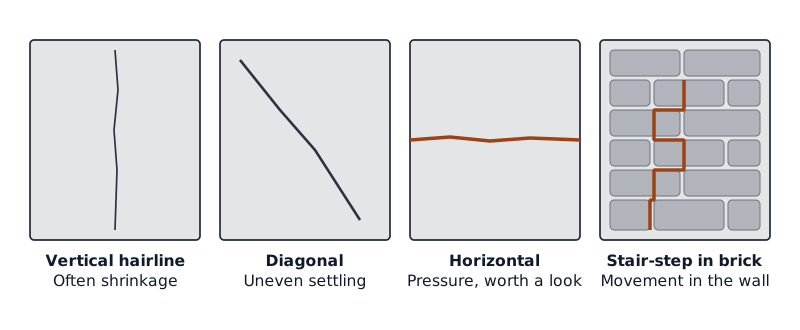
Sticking doors can indicate foundation movement, but on their own they prove very little. What matters is the pattern. A single door that sticks in August is probably swollen wood. Several doors and windows that start sticking at once, especially on one side of the house, alongside new cracks in drywall or brick, is a pattern a foundation contractor would want to look at.
The USDA describes the Lake Charles clay, common across the area, as 45 to 60% clay that cracks half an inch to two inches wide and a foot or more deep when it dries out. Wet again, it swells, lifting or dropping parts of a slab unevenly, and the door frames above follow.
Warning signs that often show up with sticking doors:
- Diagonal cracks running up from the corners of door frames and windows
- Stair-step cracks in brick veneer
- Gaps opening between walls and the ceiling or floor
- Floors that slope enough to notice when you walk
- Windows that suddenly will not open or lock
The difference between ordinary settling and movement that needs a fix is covered on foundation settling signs.
Why do doors stick in summer but not in winter?
Doors usually stick in summer because humid air makes the wood swell, then they loosen when drier air shrinks it back. The US Forest Products Laboratory's Wood Handbook explains that wood takes on moisture from its surroundings and changes size as it does.
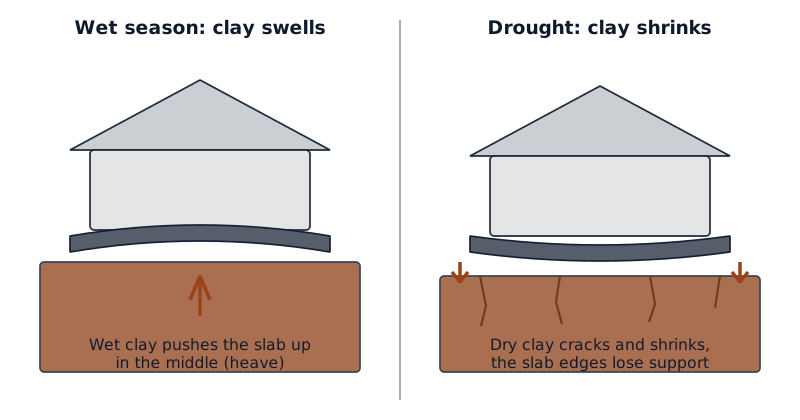
Winter sticking is the reverse case and points elsewhere. If a door sticks in the dry months and frees up after heavy rain, the clay under the house may be the cause: dry clay shrinks, part of the foundation drops, and the frame tilts. When the soil gets wet again the ground swells back. A door that tracks the rain rather than the humidity is worth noting.
You can calm the humidity side yourself. The EPA advises keeping indoor humidity below 60%, ideally between 30 and 50%. Running the air conditioning steadily, using a dehumidifier in damp rooms, and painting or sealing the top and bottom edges of wood doors all slow the swelling.
Why are sliding and patio doors sticking?
Sliding and patio doors usually stick because the track is dirty or bent, or the rollers in the bottom of the panel are worn. Grit packed into the track and flat or seized rollers make the door drag along the bottom. Cleaning the track and adjusting or replacing the rollers fixes most of them. When the panel binds at the top or the gap tapers, the frame may have moved.
Sliding glass doors are a useful test because the glass panel does not swell. If the rollers are good and the track is clean but the door still rubs, the opening has likely changed shape. Bifold and sliding closet doors that start jumping their tracks can point the same way.
The full checklist, from vacuuming the track to measuring the opening corner to corner, is on sliding glass doors sticking.
When should you call a professional about doors sticking?
Call a professional when the sticking does not match the weather, when it comes with new cracks, or when several doors change at once. Fixing the door hides the symptom; if the foundation keeps moving, the door will bind again and the cracks will keep growing. A foundation inspection costs about $300 to $1,000 in Houston, with an average of about $600, according to a 2026 Houston Press guide.
Before the visit, note which doors and windows stick and since when, and photograph any cracks near frames.
Older pier-and-beam homes behave differently from slab homes. In the Houston Heights, where city design guidelines describe most houses as wood-sided bungalows on pier-and-beam foundations, sticking doors often follow a sinking or rotting pier, which can usually be reset or shimmed from the crawl space. The repair options for that kind of house are on pier-and-beam foundation repair. Most newer Houston homes sit on a concrete slab, and slab foundation repair explains what lifting one involves.
What does it cost to fix doors sticking from foundation movement?
If the cause is the foundation, the door is the cheap part; the cost is in stabilizing the house. Most Houston foundation repair jobs cost $3,300 to $6,800, according to the 2026 Houston Press guide, and pressed concrete piers run about $300 to $600 each. A door that sticks from swelling or a loose hinge often costs nothing but your time.
| Cause | Typical fix | Typical range |
|---|---|---|
| Swollen wood, loose hinge, paint | DIY: tighten, seal, wax, plane | Your time and a few supplies |
| Unsure if it is the foundation | Foundation inspection, Houston | $300 to $1,000 |
| Need an engineer's view | Structural engineer report | $500 to $1,000 |
| Slab or beam has dropped | Pressed concrete piers, each | $300 to $600 |
| Typical Houston repair job | Piering and leveling | $3,300 to $6,800 |
The engineer figure is from This Old House's national guide; the rest are Houston figures. They are a guide only; the written quote sets the real price. Once a house is leveled, doors usually need adjusting or rehanging to suit the new position. The full breakdown is on foundation repair cost in Houston. To find out which you have, we'll arrange a visit from a local foundation contractor, and you get a written quote before any work starts.
Questions people ask
Why are my cabinet doors sticking?
Cabinet doors usually stick because of fresh paint, swollen wood or a hinge that needs adjusting. Painted cabinet doors can take weeks for the finish to harden fully, and soft paint grabs the frame. Most cabinet hinges have small adjustment screws that move the door up, down or sideways. Cabinets are fixed to walls and rarely reveal foundation movement unless the whole run has tilted.
Why are the locks on my doors sticking?
A sticking lock is usually dirt or wear inside the cylinder, or a bolt that no longer lines up with the strike plate. If the key turns freely with the door open but hard with it closed, the door has dropped or the frame has moved, so the bolt rubs. Moving the strike plate fixes the symptom; if several locks change together, look at the foundation.
What are ovolo sticking doors?
Ovolo sticking has nothing to do with doors that jam. In joinery, the sticking is the molded profile cut along the inside edges of a door's stiles and rails, and an ovolo is a convex, rounded profile, roughly a quarter circle. So an ovolo sticking door is a paneled door with that rounded edge detail around each panel. It is a style choice, not a fault.
How do you keep car doors from sticking in cold weather?
Car doors usually stick in freezing weather because water in the rubber seals turns to ice. Commonly recommended steps are to wipe the seals dry before a freeze and treat them with a silicone-based rubber protectant. Houston freezes are rare, so this tends to matter only on the odd hard frost.
Is it normal for doors to stick in a new house?
Some sticking in the first year or two is common as the framing lumber dries and the house settles onto its foundation. Small adjustments to hinges and strikes usually fix it. A new home whose doors keep getting worse, or that shows diagonal cracks above frames, should be looked at, ideally while any builder's warranty still applies.
Read on
- Foundation signs of problems
The inside and outside signs of foundation problems in a Houston home, which ones are normal and which mean a slab or pier-and-beam house…
- How to fix sticking doors
Find where a door rubs, tighten or shim the hinges, move the strike, free painted doors and plane only as a last resort.
- Sliding glass doors sticking
Why a sliding glass door sticks, how to clean the track and adjust the rollers, and the measurements that show when a Houston foundation…
More services are listed on foundation repair across Houston.
Sources
- USDA Forest Products Laboratory, Wood Handbook chapter 4, moisture relations of wood (2021)
- US EPA, a brief guide to mold, moisture and your home
- USDA NRCS, Lake Charles soil series description
- Houston Press, guide to foundation repair in Houston (2026)
- This Old House, foundation repair cost guide (October 2026)
- Houston Heights design guidelines, City of Houston Planning
- Fine Woodworking, mitered molding and sticking profiles on frame and panel doors
Last changed