Foundation settling is the slow downward movement of a house as the soil beneath it compresses under the weight. A little, spread evenly, is normal and harmless. It becomes a problem when one part of the house sinks more than another, which pulls the frame out of square and shows up as cracks, sticking doors and sloping floors. In Houston, settling is driven mostly by clay soil that shrinks in drought and swells after rain. This page explains how to tell normal settlement from sinking, what to do first, what repair costs, and how long a house keeps moving afterward.
What is foundation settling, and why does it happen in Houston?
Foundation settling happens when the soil under a slab or pier-and-beam house compresses, dries out or washes away, and the house drops with it. Every house settles a little after it is built. Houston adds harder soil conditions than most cities: heavy clay that changes volume with moisture, plus land subsidence. Uneven settling, where one corner or side drops further, is the kind that damages a house.
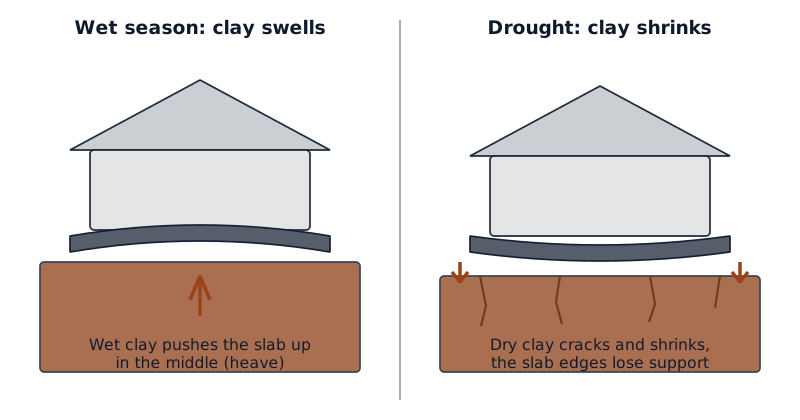
Most of the metro sits on clays such as the Lake Charles series, which the USDA describes as 45 to 60% clay. When it dries, it splits open in cracks half an inch to two inches wide that reach a foot or more down, and in most years those cracks stay open for 60 to 90 days in total. East of the Trinity River, the Beaumont clay behaves in a similar way. As the clay shrinks, the edge of a slab loses support and dips. When rain returns, the same soil swells and can push sections up instead, which is called heave and is covered on foundation heave repair.
The ground itself is also sinking in places. The USGS recorded more than 10 feet of subsidence near Pasadena between 1906 and 1995, and the Harris-Galveston Subsidence District now measures the fastest rates, over 3 cm a year, around Katy and Fulshear. Subsidence lowers whole neighborhoods fairly evenly, so it rarely cracks a house on its own, but it can change how water drains.
How serious is foundation settling?
Most foundation settling is cosmetic: hairline cracks in drywall or a slab that do not grow. It turns serious when the movement is uneven and ongoing, because the house frame bends to follow it. Wide or widening cracks, doors that stop latching, floors you can feel sloping and gaps around windows point to differential settlement, which usually needs a repair rather than a coat of paint.
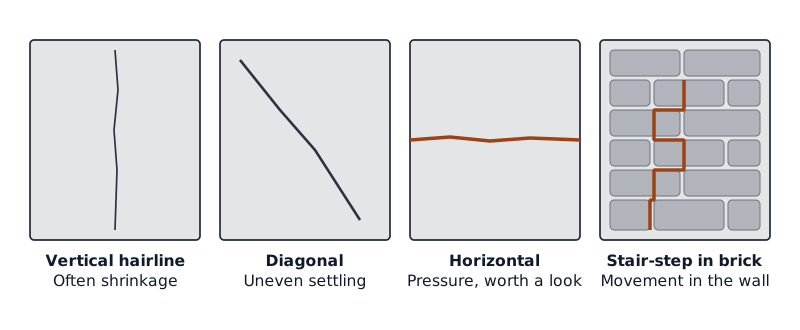
| What you see | Usually normal settling | Worth a professional look |
|---|---|---|
| Wall cracks | Straight hairlines at drywall seams that stay put | Growing cracks, or diagonals from door corners |
| Slab cracks | Thin shrinkage lines in a garage floor | One side of the crack higher than the other |
| Doors | Sticking only in the wettest weeks | Doors that will not latch |
| Floors | A barely noticeable slope | A slope you can feel underfoot |
| Outside | Backfill sunk next to the slab | Stair-step cracks in brick |
Fine lines matter only if they move. More examples are in normal settling vs foundation issues. This Old House notes that a hairline crack sealed for $250 to $800 can become a $10,000 to $15,000 repair if left to grow.
What should you do if your foundation is settling?
Start by measuring, not guessing. Mark the ends of each crack with a pencil and the date, photograph them, and check again after a month and after the next long dry spell. Look at your gutters and the soil next to the house, since water pooling against the slab speeds up settling. If cracks grow or doors keep getting worse, ask for a foundation inspection.
Dirt settling around the foundation is common, because backfill placed against a new slab is looser than undisturbed ground and sinks over time. That gap is a drainage problem, not a foundation failure: top it up so the soil slopes away from the walls. In long droughts, keep the soil around the slab evenly moist so it does not crack open. The difference between ordinary settling and a structural problem is set out in foundation problems vs settling.
How much does it cost to fix a settling foundation?
Most settling repairs in Houston cost $3,300 to $6,800, according to a 2026 Houston Press guide, with the number of piers driving most of the price. Small jobs such as sealing cracks or lifting one slab section cost far less. Severe settling that needs a whole house lifted and leveled can reach $20,000 to $23,000, according to This Old House.
| Repair for settling | Typical range | Source |
|---|---|---|
| Foundation inspection | $300 to $1,000 | Houston guide, 2026 |
| Crack filling | $250 to $800 | National guide, 2026 |
| Mudjacking or slabjacking | $550 to $1,300 | National guide, 2026 |
| Pressed concrete pier, each | $300 to $600 | Houston guide, 2026 |
| Steel pier, each | $1,000 and up | Houston guide, 2026 |
| Typical Houston repair job | $3,300 to $6,800 | Houston guide, 2026 |
| Lifting and leveling, severe settling | $20,000 to $23,000 | National guide, 2026 |
Inside the City of Houston, foundation repair needs a building permit. These figures are a guide; the written quote after a visit sets your price. The full breakdown is on foundation settling repair cost, and the methods themselves are on how to repair a settling foundation.
Can a 50 year old house still settle?
Yes. An older house has usually finished the settling that comes from its own weight, but the soil under it keeps reacting to water. In Houston, clay that dries in a drought and swells after storms can move a 50 or 70 year old house as easily as a new one. A failed drain line, a new tree or changed grading can start fresh movement too.
Older homes in the Houston Heights, many of them Craftsman bungalows from 1905 to 1925, mostly sit on pier and beam. There, settling shows as sagging floors from sunken or rotted piers, which can be reset or shimmed from the crawl space.
Do houses eventually stop settling?
Houses on firm, stable ground do mostly stop settling, typically after the first few years once the soil has compressed under the load. On Houston's expansive clay they never stop moving completely, because the soil keeps shrinking and swelling with the weather. What you want is movement small and even enough that the house does not crack, which good drainage and steady soil moisture help achieve.
That is why piers are the standard repair here: they carry the house past the most active clay to firmer ground. How they are chosen and placed is on foundation piers in Houston.
How long does it take for a house to settle after foundation repair?
Expect a period of small adjustments for a few weeks to a few months after a lift, as the frame, drywall and doors catch up with the new level. New hairline cracks or a door that needs adjusting in that time are common and usually minor. Mudjacking material needs 24 to 72 hours to cure, the Houston Press guide says, before the slab is fully supported.
Ask whether a follow-up level check is included, and keep the pier log and level readings with your house papers for a future buyer.
Settling also leaves its own kind of crack. The guide to normal foundation settling cracks shows what ordinary settling looks like in a Houston house.
Questions people ask
When should you walk away from foundation issues?
Walk away from a house purchase when the seller will not allow an inspection, when an engineer finds active movement the price does not reflect, or when repair quotes approach what the discount is worth to you. Previous repairs with paperwork are a different matter. The trade-offs are covered on when to walk away from foundation issues.
How long does foundation settling take?
Settling from a house's own weight mostly happens in the first few years after building, though the time varies with the soil. Seasonal movement on Houston clay is different: it repeats every dry and wet cycle for the life of the house. If cracks keep growing year after year, the movement is ongoing and worth having checked.
What should I ask before I hire someone for foundation settling?
Ask what is causing the movement, how many piers they propose and where each one goes, what pier type and depth they expect, whether a building permit is included, and whether an engineer will review the plan. Ask for the price, the follow-up visits and any warranty terms in writing. Compare quotes line by line, not just on the total.
Is a settling condo foundation the owner's problem?
Usually not on your own. In most condos the foundation is a common element, so the homeowners association arranges and pays for the repair, often through its reserve fund or a special assessment. Check your association's declaration to see who is responsible, and report cracks or sticking doors to the association in writing with photos and dates.
Read on
- Foundation heave repair
Foundation heave repair in Houston: why clay pushes a slab up, why it can't be pushed back down, and how a contractor levels the house…
- Settling, soil and movement
Foundation problems vs settling in Houston: a side-by-side table of the signs, why clay soil blurs the line, simple checks to run, and…
- Costs
What it costs to fix a settling foundation in Houston in 2026: prices by repair, how clay soil and pier count change the total, and the…
See Foundation Repairs Houston Quotes foundation repair for the other services and what they cost.
Sources
- USDA NRCS, Lake Charles soil series description
- USDA NRCS, Beaumont soil series description
- USGS Fact Sheet 110-02, land subsidence in the Houston-Galveston region
- Harris-Galveston Subsidence District, 2025 annual groundwater report summary
- Houston Press, guide to foundation repair in Houston (2026)
- This Old House, foundation repair cost guide (October 2026)
- City of Houston weekly building permit report, July 2024
- Houston Heights design guidelines, City of Houston Planning
Last changed