Katy homes need foundation repair for a reason most of Houston no longer has: the land itself is still dropping, and fast. The Harris-Galveston Subsidence District's 2025 report puts its highest measured rate, over 3 cm a year, in the Katy and Fulshear area. That steady sinking, the chance of old faults waking up, and a loamy soil unlike the clays closer to the coast shape what goes wrong and what fixes it. This page covers each, what repairs cost, and how we'll arrange a visit. Other places we cover are on the Houston areas page.
Is the ground under Katy really still sinking?
Yes. Katy is where the region's subsidence monitors now record the fastest sinking. The Harris-Galveston Subsidence District measured over 3 cm a year at a GPS station in the Katy and Fulshear area in 2025. On the Fort Bend side, station P111 in Katy has dropped about 10.7 cm since 2021, an average of 3.31 cm a year from 2020 to 2024. Near Pasadena, by contrast, sinking largely stopped after the switch to surface water in the late 1970s.
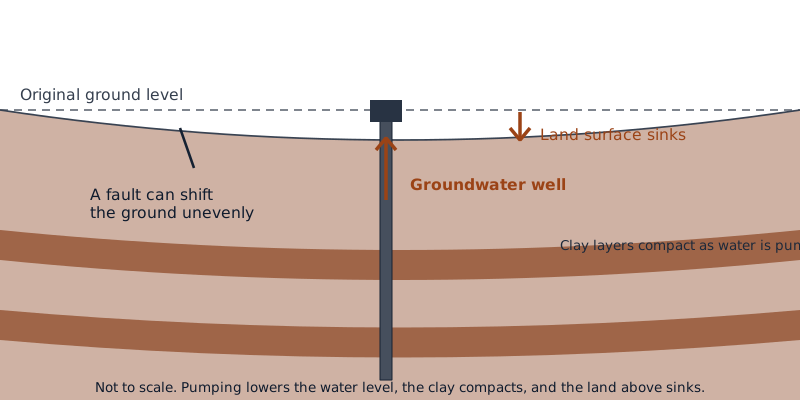
Even sinking does little harm by itself. A whole subdivision going down together keeps a slab level. The trouble starts where the rate changes over a short distance, or where a fault concentrates the movement. That uneven drop is what bends a slab and cracks brick.
Katy sits where Harris, Fort Bend and Waller counties meet, so the subsidence district that tracks your street depends on which side of the line you live. Sugar Land falls under the same Fort Bend district, but its station P004 has slowed to about 0.61 cm a year, a useful contrast with Katy's pace.
Could a fault line be moving under a Katy house?
It's possible, and worth ruling out. A University of Houston team led by geologist Shuhab Khan found substantial subsidence in Katy and wrote that faults in Katy and The Woodlands will likely become reactivated if current groundwater pumping trends continue. A moving fault damages any house built across it, however well the foundation was laid or repaired.
The USGS has recorded homes elsewhere in the Houston-Galveston region damaged by fault creep, so this isn't a theoretical risk. Signs that point to a fault rather than ordinary settling: cracks that line up across the slab, the driveway and the street, one end of the house sitting lower in a straight line, or several neighbors on the same line with the same damage. If you see that pattern, ask for a foundation inspection that looks past your own lot before anyone quotes for piers.
Does Katy's soil behave like the clay in the rest of Houston?
Not quite. The USDA's Katy soil series, typed near Fulshear in Fort Bend County, is a loamy soil formed from the Lissie Formation. Its surface layer holds only 3 to 14% clay, rising to 13 to 35% and then 25 to 45% deeper down. Compare that with the Lake Charles clay further south and east at 45 to 60% clay. The Katy series is moderately well drained, with moderately slow permeability.
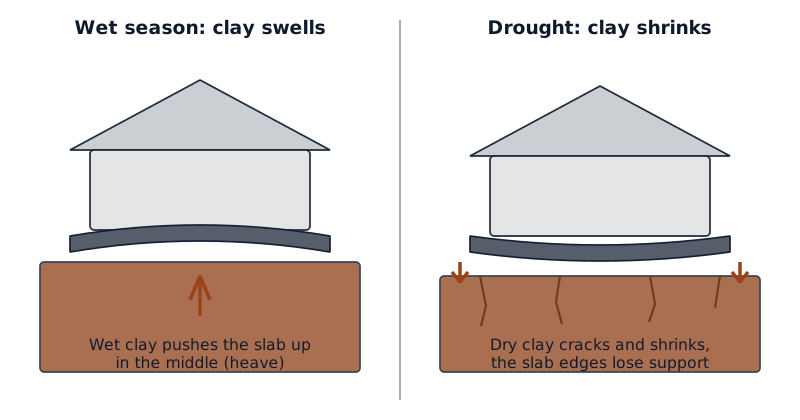
The detail that matters most for a foundation is water. The USDA notes a seasonal water table that forms in the upper layers during cool months and wet spells, on ground with slopes mostly under 1%. Flat land with water sitting near the surface in winter is why yard grading and gutters matter here. Good foundation drainage keeps that seasonal water from softening the soil under one side of the slab while the other stays dry.
What should a Katy foundation inspection look for?
A useful inspection in Katy separates three causes: regional subsidence, a possible fault, and local soil and drainage problems. It should record floor levels across the whole slab, map cracks inside and out, check how water drains off the lot, and note whether neighbors show matching damage. Each cause has a different fix, and only the third is fully solved by work on your own lot.
Like most Houston-area homes built since the 1960s, many Katy houses sit on a slab, so the usual repair, where the slab has dropped unevenly, is slab foundation repair with piers under the failing section. Piers lift and hold a slab against local settling. They can't stop the whole area sinking, and they can't hold back a fault.
What does foundation repair cost in Katy?
Expect Houston-area prices: most foundation repair jobs here run about $3,300 to $6,800, with pressed concrete piers at $300 to $600 each and steel piers from about $1,000. An inspection averages about $600. A soil report, which often makes sense on fast-moving ground, runs $500 to $3,000 on national figures. These are guides; the local foundation contractor quotes the real price after seeing your house.
What pushes a Katy job up is uncertainty. If a fault might be involved, paying for a structural engineer report ($500 to $1,000) before piers is cheaper than lifting a slab that keeps moving. Interior piers add about 15%, and tight access adds 6 to 8% to pier costs. The foundation repair cost page breaks the ranges down by repair type.
Questions people ask
Is Katy a bad place to buy a house because of subsidence?
Not necessarily. Steady, even subsidence across a neighborhood rarely damages a single house. What to check before buying is whether the house shows uneven movement: sloping floors, cracks that line up through the slab and driveway, or doors that won't latch. A pre-purchase foundation inspection with floor elevations gives you a baseline, and a second reading a year later shows whether movement is ongoing.
Will piers stop my Katy house sinking with the land?
No. Piers transfer the house's weight to deeper soil so one part of the slab can't drop faster than the rest. The whole area, including that deeper soil, is still sinking at the rates the subsidence districts measure. Piers fix uneven settling; they don't take your house out of regional subsidence, and they won't hold against an active fault running under the lot.
Do I need a permit for foundation repair in Katy?
It depends on where your home sits. Katy spans three counties, so the office that covers your job depends on your address. If you live inside the City of Katy, ask its building department before work starts. A local foundation contractor should know which office covers your street and include any permit in the written quote.
Every area we cover is listed on foundation repair in Houston.
Sources
- Harris-Galveston Subsidence District, 2025 annual groundwater report summary
- Fort Bend Subsidence District, 2024 annual groundwater report
- USDA NRCS, Katy soil series description
- University of Houston, subsidence study news release (October 2022)
- USGS Fact Sheet 110-02, land subsidence in the Houston-Galveston region
- Houston Press, guide to foundation repair in Houston (2026)
- This Old House, foundation repair cost guide (October 2026)
Last changed