Foundation repair in Houston usually means putting piers under a slab or a pier-and-beam house to stop it moving, then lifting it back toward level. Most Houston jobs land between about $3,300 and $6,800, according to a 2026 Houston guide, though a large pier job can cost far more. The reason it's so common here is the ground: much of the Houston area sits on heavy Gulf Coast clay that swells when wet and shrinks in drought. This page covers what repair costs, the signs worth acting on, how the main repair methods work, and how a visit runs.
How much does foundation repair cost in Houston?
Most foundation repair jobs in Houston cost about $3,300 to $6,800, according to a 2026 Houston Press guide. Nationally, This Old House puts the typical range at $2,224 to $8,134, with an average of $5,179. The number of piers is the biggest driver: each concrete pier runs about $300 to $600 in Houston, and steel piers start around $1,000 each.
| Work | Typical range | Source |
|---|---|---|
| Foundation repair, typical Houston job | $3,300 to $6,800 | Houston guide, 2026 |
| Concrete pressed pier, each | $300 to $600 | Houston guide, 2026 |
| Steel pier, each | $1,000 and up | Houston guide, 2026 |
| Crack filling | $250 to $800 | National guide, 2026 |
| Mudjacking or slabjacking | $550 to $1,300 | National guide, 2026 |
| Structural engineer report | $500 to $1,000 | National guide, 2026 |
| Foundation inspection | $300 to $1,000 | Houston guide, 2026 |
What moves the price:
- How many piers. A corner that has dropped might need six piers. A house settling along a whole side might need twenty or more.
- Pier type. Pressed concrete pilings are the common choice in Houston. Steel and helical piers cost more per pier.
- Interior work. Piers under interior walls mean breaking through the slab inside, which the Houston guide says adds about 15%.
- Access. Tight side yards, decks and landscaping add work. The same guide puts access problems at 6 to 8% on pier costs.
- Plumbing. Lifting a slab can stress the drain lines under it. Many contractors recommend a plumbing test before and after.
These are guide figures, not quotes. The contractor who visits gives you the real price in writing. For a full breakdown by job type, see the foundation repair cost guide for Houston, and for per-pier detail the pier foundation cost page.
Why do so many Houston foundations need repair?
Houston foundations move mainly because of the soil. The USDA describes the Lake Charles clay, typed in Fort Bend County and found across southeast Texas between the Colorado and Trinity rivers, as 45 to 60% clay. When it dries, it cracks up to about 2 inches wide and a foot or more deep, and those cracks stay open 60 to 90 days in most years. Soil that shrinks and swells that much lifts and drops a slab with the seasons.
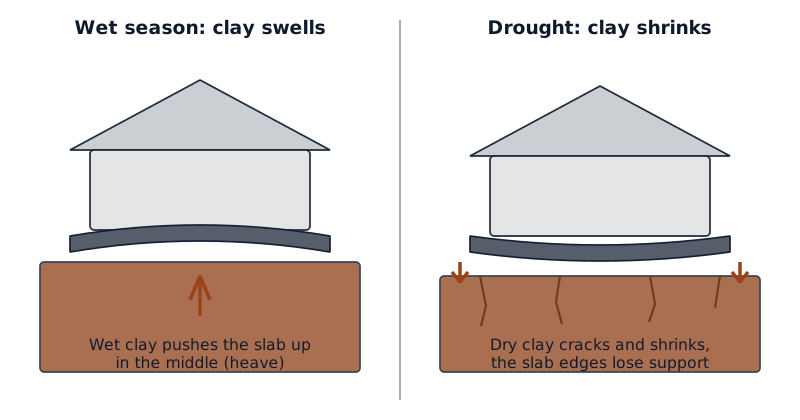
Three things make Houston harder on foundations than most cities:
- Expansive clay. The Lake Charles and Beaumont clays both shrink and crack when dry. A slab sitting on them gets pushed up when the clay is wet and loses support at the edges in a dry summer. There is more on foundation settling and Houston soil.
- Subsidence. Decades of groundwater pumping lowered the land itself. USGS measured more than 10 feet of subsidence near Pasadena between 1906 and 1995, and the Harris-Galveston Subsidence District's 2025 report puts today's fastest sinking, over 3 cm a year, in the Katy and Fulshear area.
- Water extremes. During Hurricane Harvey, 47.4 inches of rain fell at Clear Creek and I-45 in four days, according to the Harris County Flood Control District. Long droughts followed by floods are exactly what clay soils react to.
The water around your house matters as much as the soil under it. Gutters that dump at the slab, flat yards that hold water, and big trees drawing moisture from one side all make movement uneven. That's why foundation drainage is often part of a lasting repair.
What are the signs your foundation needs repair?
The most common signs are doors that stick or won't latch, cracks in drywall running from the corners of doors and windows, stair-step cracks in brick, gaps between walls and the ceiling, and floors that slope or feel uneven. One sign alone may be normal settling. Several together, or cracks that keep growing, are worth a professional look.
Signs to watch, inside and out:
- Doors and windows. Doors that rub at the top corner or swing open by themselves. See why doors stick in Houston houses.
- Drywall cracks. Diagonal cracks from door and window corners, or cracks that reopen after patching.
- Brick veneer. Stair-step cracks along the mortar joints, or brick pulling away from window frames.
- Floors. A marble that rolls across the room, or a 1 inch drop from one side of a room to the other. See how to fix uneven floors.
- Outside the slab. Cracks in the exposed slab edge, gaps where the slab meets the brick, or soil pulled away from the foundation in a dry summer.
A crack's width and direction say a lot. Our guide to when foundation cracks are a worry and the early signs of foundation problems with pictures explain what's cosmetic and what isn't.
What foundation repair methods are used in Houston?
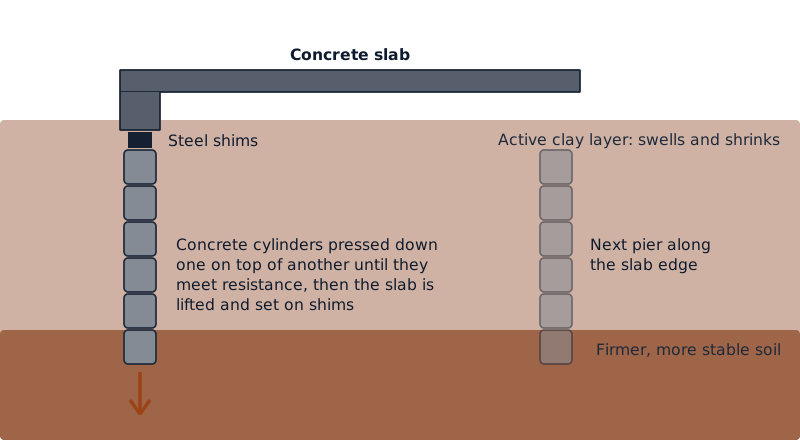
Most Houston repairs use underpinning: piers driven or drilled under the foundation down to firmer soil, then the house is lifted and shimmed back toward level on them. Pressed concrete pilings are the most common method here. Steel push piers and helical piers are used when deeper support is needed. Shallow slab lifting, such as mudjacking, suits driveways and patios more than houses.
| Method | How it works | Typical use in Houston |
|---|---|---|
| Pressed concrete pilings | Concrete cylinders pressed down with a hydraulic jack until they meet resistance | The most common slab repair |
| Steel push piers | Steel pipe driven down against the weight of the house | Deeper stable soil, heavier homes |
| Helical piers | Steel shafts with helix plates screwed into the ground | Lighter loads, tight access, new additions |
| Drilled bell-bottom piers | Holes drilled and filled with reinforced concrete, flared at the base | Engineer-specified jobs |
| Shimming and new supports | Steel shims and new blocks under a pier-and-beam house | Pier-and-beam leveling |
| Mudjacking or foam lifting | Slurry or foam pumped under a slab to raise it | Driveways, sidewalks, patios |
Each has a page of its own: foundation piers, helical vs push piers, foundation leveling and mudjacking in Houston. The aim of every method is the same: stabilize the house so the movement stops, then lift it as close to level as the structure allows. Few houses come back perfectly flat, and a good contractor says so up front.
Is it possible to repair a foundation?
Yes. Almost every settled or cracked slab and pier-and-beam foundation in Houston can be repaired by supporting it on piers and lifting it back toward level. Full replacement is rare and usually only considered when the slab itself has broken up badly. Repair is far cheaper than replacement and you can usually stay in the house.
What repair can and can't do:
- It stops further settling in the areas where piers go in.
- It lifts the house back toward level, often closing cracks and freeing doors.
- It doesn't fix cosmetic damage already done. Drywall, brick and trim repairs come after.
- It doesn't stop the clay moving. Good drainage and steady soil moisture are still on you.
If the problem is only hairline cracks in the slab with no movement, foundation crack repair with epoxy or sealant may be enough.
Slab or pier and beam: does the type of foundation matter?
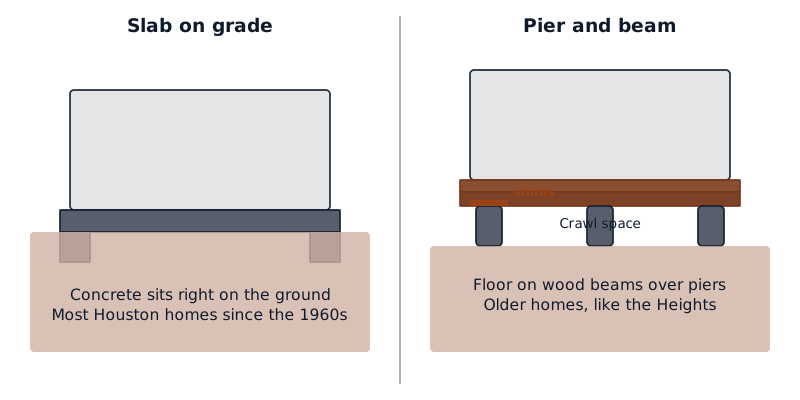
Yes, the type of foundation changes the repair. Most Houston houses built since the 1960s sit on a concrete slab on grade, repaired with piers pressed under the slab edge and interior. Older homes, like the 1905 to 1925 Craftsman bungalows of the Heights, often sit on pier and beam, where the repair is usually reshimming, new piers and replacing rotted beams or joists in the crawl space.
| Slab on grade | Pier and beam | |
|---|---|---|
| Where you'll find it | Most houses built in the last 60 years | Older neighborhoods like the Heights |
| Common problem | Edge or corner settling, heave in the middle | Sagging floors, failed shims, rot |
| Usual repair | Pressed pilings, then lift | Reshim, new piers, beam or joist repair |
| Access | Digging outside, breaking through inside | Crawl space under the house |
See slab foundation repair, pier and beam foundation repair and the comparison of pier and beam vs slab.
What is a pier for a foundation, and how deep does it go?
A foundation pier is a column placed under a house to carry its weight down to firmer soil, below the layer that shrinks and swells. In Houston, pressed concrete pilings are usually driven until the hydraulic jack meets enough resistance, which is often several feet down. Steel and helical piers can reach much deeper. The right depth depends on the soil at your house, not a fixed number.
How long piers last depends on the type and the soil around them. Steel and concrete piers are built to last for decades. What fails more often is the soil moisture around the house and the shims on top of the piers, which is why some contractors offer a warranty on the piers and a periodic adjustment. Read the warranty terms closely: many cover the piers only and exclude plumbing leaks, drainage problems and tree roots.
What time of year is best for foundation repair in Houston?
Foundation repair can be done any time of year in Houston. Many contractors prefer to lift a house when the soil is at a normal moisture level rather than at the end of a long drought, when the clay has shrunk, or right after heavy rain, when it has swelled. The bigger risk is waiting: movement and damage keep adding up whatever the season.
Some practical points:
- Late summer is when clay soils are driest and cracks often show up most. It's a good time to spot problems and get an inspection.
- After a wet spell some cracks close up again, which can make a problem look smaller than it is.
- Scheduling around Houston's heavy rain is about digging, not the repair. Wet holes slow the work.
How long does foundation repair take, and can you stay in the house?
A typical Houston slab repair with exterior piers often takes one to three days, depending on the number of piers and how much interior work there is. You can usually stay in the house throughout. Interior piers take longer, and a room may need to be cleared and the floor covering lifted where the crew breaks through the slab.
What to expect on the day:
- Holes dug along the outside of the slab where the piers go.
- Noise from the hydraulic jacks while pilings are pressed down.
- A lift, then shims set and the holes backfilled.
- Some contractors check the plumbing afterward, because lifting can shift drain lines.
Mudjacking on a driveway or patio is faster, often a few hours, but the slurry needs 24 to 72 hours to cure, according to the Houston guide.
Do you need a permit for foundation repair in Houston?
Inside the City of Houston, foundation repair needs a building permit. The city's own weekly permit report for one week in July 2024 lists 23 foundation repair permits, including residential shim, level and pier work. Cities like Bellaire, Katy and Sugar Land have their own rules, and Bellaire charges a $130 floodplain permit for residential foundation work.
Who pulls the permit is worth asking about. In most cases the contractor applies for it as part of the job. If you're asked to pull it yourself, ask why. Older homes in the Heights historic districts may also need a Certificate of Appropriateness for visible exterior changes. Each Houston area page covers the local rules where they differ.
Does homeowners insurance cover foundation repair?
Usually not. Most standard Texas homeowners policies exclude settling, soil movement and earth movement, which covers most foundation repair. There are exceptions: damage caused by a sudden covered event, such as a plumbing leak under the slab, may be covered under some policies. Read the exclusions in your own policy, and ask your insurer before work starts.
See our guides to whether home insurance pays for foundation repair and the wider insurance and foundation repair guide. If a slab leak is the cause, the foundation leak repair cost page explains the plumbing side.
What destroys the foundation of a house?
Uneven soil moisture destroys more Houston foundations than anything else. When clay under one part of the slab dries and shrinks while another part stays wet, the house bends. Poor drainage, leaking plumbing under the slab, trees drawing water from one side, and long droughts are the usual causes. Construction on poorly compacted fill adds to it.
Things you can control:
- Drainage. Gutters and downspouts that carry water well away from the slab, and soil graded to slope away from the house.
- Steady moisture. In long dry spells, some Houston homeowners water around the foundation to keep the clay from shrinking. See soaker hoses for foundations.
- Plumbing. A slab leak can wash out or swell the soil under one area. Watch for unexplained water bills or warm spots on the floor.
- Trees. Large trees close to the house can dry out the soil on one side.
Can deteriorating concrete be repaired?
Yes, if the concrete itself is sound underneath. Surface spalling, hairline shrinkage cracks and small chips in a slab edge can be patched or sealed. If the slab is breaking up, the reinforcing steel is badly rusted, or sections have dropped, the repair is structural and needs piers, not a patch. An inspection tells you which you have.
A foundation inspection or a structural engineer's report is worth it before larger work, especially if you're buying. See buying a house with foundation issues for what to ask.
How does a foundation repair visit work?
You tell us about the house and what you're seeing. We'll arrange a visit, and a local foundation contractor comes to you. They walk the house, take floor elevation readings, look at the cracks, the drainage and the plumbing signs, and then give you a written price for the work before anything starts. You decide whether to go ahead.
What to have ready for the visit:
- When you first noticed the problem and whether it's getting worse.
- Photos of cracks, ideally with a date.
- Any past repair paperwork or warranty, and any engineer report.
- Whether the house is slab or pier and beam, if you know.
Which areas of Houston do we cover?
We cover the City of Houston and the suburbs around it. Conditions differ a lot across the metro: pier-and-beam bungalows in Houston Heights, fast subsidence in Katy, historic sinking in Pasadena and Baytown, Harvey flooding in Meyerland, Kingwood and Friendswood, and separate city permits in Bellaire.
We also cover Sugar Land, Jersey Village, Cypress, Spring, The Woodlands and Clear Lake. Every area is on the areas page, and more answers are in the foundation repair guides.
Questions people ask
Where can I find foundation repair services near Houston, TX?
You can request a visit right here. Tell us your address and what you're seeing, and we'll arrange for a local foundation contractor to come to you, inspect the house and give you a written price. We cover the City of Houston and suburbs including Katy, Sugar Land, Cypress, Spring, Kingwood, Pasadena and Clear Lake.
What is the average cost of foundation repair in Houston?
A 2026 Houston guide puts most jobs at $3,300 to $6,800. The national average from This Old House is $5,179. Your price depends mostly on how many piers the house needs, whether any go inside, and access. Treat these as a guide: the real price comes in writing after a contractor has seen the house.
What happens if you don't fix a cracked foundation?
The movement usually continues, and the damage spreads: more drywall and brick cracks, doors that won't close, gaps at windows, and sometimes stress on plumbing under the slab. This Old House notes a hairline crack sealed for $250 to $800 can grow into a $10,000 to $15,000 structural repair if left. Small cracks with no movement may never need more than sealing.
Do foundation repairs devalue a home?
A documented, finished repair usually makes a house easier to sell than one with an untreated problem, because buyers' inspectors look for movement. Keep the paperwork: the repair plan, any engineer report, permit records and a transferable warranty if there is one. Buyers and lenders often ask for them.
How long does it take for a house to settle after foundation repair?
The house shouldn't keep settling where piers went in, but expect small adjustments in the first months as the soil and framing respond. Some new hairline cracks or a sticking door can appear and are often minor. Wait a few weeks before cosmetic repairs, and keep up drainage and soil moisture so the clay around the house stays steady.
Can you repair a foundation yourself?
Sealing small non-structural cracks and fixing drainage are reasonable DIY jobs. Lifting a house is not: it needs hydraulic equipment, the right pier depth for the soil, and in the City of Houston a building permit. Our guide to DIY foundation repair covers what you can do safely and when to call a professional.
Start here
- Foundation cracks
Foundation crack repair in Houston: which cracks matter, how they get fixed, what the work costs, and a written quote after a local…
- Foundation piers
How foundation piers work under Houston homes: pressed concrete, steel and helical piers, how deep they go, how many you need and what…
- Slab foundation repair
How a concrete slab foundation is repaired in Houston: the methods, what each costs, what the clay does to a slab, and a written price…
- Pier and beam foundation repair
How a pier and beam house works, what goes wrong under Houston floors, how repairs and crawl space encapsulation are done, and what they…
- House leveling
How foundation leveling works on Houston slab and pier-and-beam homes: the methods, how long it takes, what it costs and when it is worth…
- Costs
What foundation repair costs in Houston in 2026, price ranges by repair method, what pushes a quote up or down, and how to compare written…
- Buying a house
Thinking of buying a Houston house with foundation issues?
- DIY foundation repair
Which foundation jobs a Houston homeowner can do alone, which need a permit and a contractor, and what DIY saves next to a professional…
- Home warranty and foundations
Why a Texas home warranty rarely pays for foundation repair, where it can help with a slab leak, and how builder and repair warranties…
- Cost per square foot
Is foundation repair priced per square foot?
- Foundation repair free estimate
What a free foundation repair estimate in Houston covers, what a written estimate should list, and typical costs for block walls, straps…
- Steel foundation shims
What steel foundation shims do, where they sit on slab and pier-and-beam homes, how they compare with wood, whether they rust, and when to…
- When to walk away
The foundation problems that should end a Houston house deal, the cost test to run, the Texas option period deadline, and when an owner…
- Insurance and foundation repair
When a Texas homeowners policy pays for foundation repair, when it refuses, how a plumbing leak changes the answer, and what the repair…
- Signs of foundation problems
Why doors stick in Houston homes, how to tell humidity from foundation movement, what you can fix yourself and what a foundation check and…
- Foundation cracks
Vertical vs horizontal foundation cracks on Houston homes: what each direction usually means, how to check a crack, what repair costs and…
- Foundation drainage
Foundation drain vs French drain on Houston clay: where each pipe sits, what it catches, what it costs, and which one a slab or…
- Slab leaks and plumbing
Water at your Houston slab: how a foundation drainage pipe works, how to tell it from a slab leak, how leaks are found, and what detection…
- Foundation drainage
How foundation drainage works on Houston clay: French drains, footing drains, how deep and how sloped, what goes wrong, and what a drain…
- Foundation inspection and engineers
What a foundation inspection in Houston covers, who should do it, what it costs ($300 to $1,000), the signs that call for one and what the…
- Settling, soil and movement
Foundation problems vs settling in Houston: a side-by-side table of the signs, why clay soil blurs the line, simple checks to run, and…
- Settling, soil and movement
Foundation settling in Houston: what is normal, when sinking needs repair, what it costs to fix, and how long a house keeps moving after…
- Foundation piers
Helical vs push piers for a Houston house: how each steel pier works, when one beats the other, what they cost per pier and how they…
- Mudjacking and slab lifting
What mudjacking is, how it lifts sunken driveways, sidewalks and slabs in Houston clay, what it costs, how it compares with foam, and when…
- Pier and beam vs slab
Pier and beam foundation vs slab for Houston homes: a side-by-side table, build and repair costs, post-tension slabs, crawl space care and…
- Mudjacking and slab lifting
Polyjacking vs mudjacking compared for Houston driveways, patios and slabs: materials, hole size, cure time, cost and which one suits wet…
- Foundation watering and trees
How a soaker hose protects a Houston slab on clay soil: where to lay it, how long to run it, which hose to buy, its limits, and when a…
- Insurance and foundation repair
What a Texas homeowners policy usually covers for foundation damage, why settling is excluded, how a slab leak claim works and what an…
- Costs
What foundation crack repair costs in Houston in 2026, from a $250 crack seal to a pier job, what pushes the price up, and when a crack…
- Costs
What a foundation drainage system costs in Houston in 2026: French drain prices per foot, exterior versus interior, outlets, and what…
- Costs
What a foundation inspection costs in Houston in 2026, from a $300 visit to a $1,000 engineer report, what changes the price and what you…
- Costs
What a leak under a Houston slab costs to find and fix in 2026: detection, spot repairs, tunneling, rerouting, and the foundation work a…
- Costs
What foundation leveling costs in Houston in 2026: price ranges per pier and per job, what pushes a quote up or down, and the extras to…
- Costs
What it costs to fix a settling foundation in Houston in 2026: prices by repair, how clay soil and pier count change the total, and the…
- Costs
What a foundation watering system costs in Houston in 2026, from a $30 soaker hose to an installed drip line on a timer, and what moves…
- Costs
What mudjacking costs in Houston, per square foot and per job, for driveways, patios and garage floors, what moves the price and when foam…
- Costs
What pier and beam foundation repair costs in Houston: prices per pier, crawl space encapsulation, what pushes a job up or down, and how…
- Costs
What foundation piers cost per pier in Houston: pressed concrete, steel push and helical piers, full job totals, the extras and what moves…
- Costs
What slab foundation repair costs in Houston in 2026: prices by method, what pushes a concrete slab job up or down, and the extra costs to…
Sources
- USDA NRCS, Lake Charles soil series description
- USDA NRCS, Beaumont soil series description
- USGS Fact Sheet 110-02, land subsidence in the Houston-Galveston region
- Harris-Galveston Subsidence District, 2025 annual groundwater report summary
- Harris County Flood Control District, Hurricane Harvey flood report
- City of Houston weekly building permit report, July 2024
- This Old House, foundation repair cost guide (October 2026)
- Houston Press, guide to foundation repair in Houston (2026)
Last changed