Settling is the small, even, one-time movement every house makes as the soil under it compresses. It stops, and it leaves hairline cracks and little else. A foundation problem is movement that is uneven, still going on, or big enough to bend the structure: cracks that widen, doors that keep jamming, floors that slope more each season. The quickest test is change over time. If nothing gets worse over a few months, you're probably looking at settling. In Houston the line is blurrier than elsewhere, because the clay here never really stops moving. This page sits within our guide to foundation settling in Houston and compares the two side by side.
What is the difference between house settling and foundation problems?
The difference is how much the house moves, how evenly, and whether it has stopped. Normal settlement is the whole house easing down a little as the soil firms up under its weight, mostly in the first few years. A foundation problem is differential movement: one part sinking or lifting more than another, so the frame twists and the damage keeps growing. Settling is cosmetic. A problem is structural.
| Normal settling | Foundation problem | |
|---|---|---|
| Cracks in drywall | Hairline, often at door and window corners, stay the same | Widen over months, diagonal, reopen after patching |
| Cracks in a slab or brick | Thin, straight, no edge higher than the other | Wider, stair-step in brick, one side of the crack higher |
| Doors and windows | Stick in humid weeks, then free up | Jam all year, gaps open at the top of the frame |
| Floors | Feel level | Slope you can see, or a marble rolls one way |
| Timing | Mostly early in a house's life, then stops | Keeps going, or comes and goes with drought and rain |
| What it needs | Patch and paint, watch it | A visit, a measured survey, often a repair |
My honest verdict for Houston homes: true one-and-done settling is less common here than in places with sandy or rocky ground. Most of the movement people see is the clay swelling and shrinking, and that keeps happening for the life of the house. So the question that matters isn't "settling or problem?" but "is it small and stable, or is it growing?"
What does normal settling look like, compared with foundation problem pictures?
Normal settling looks boring in photos: a hairline crack running up from the corner of a door frame, a thin straight line across a garage slab, a tiny gap where trim meets the ceiling. Foundation problem pictures show something different: brick cracked in a stair-step pattern, a crack you can slip a coin into, a door frame out of square, or a slab crack where one edge sits higher than the other.
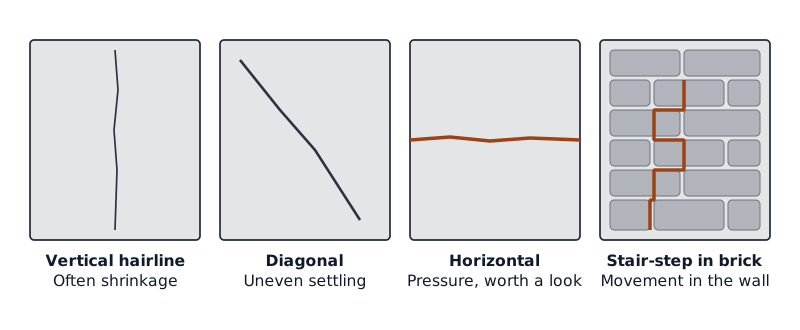
When you compare your house with pictures online, look for these details rather than the crack itself:
- Offset. If one side of a crack is higher or pushed out further, the ground under it moved more. That points to sinking, not settling.
- Shape. Long diagonal cracks from window and door corners, or stair-step lines through mortar, follow the direction the wall is being pulled.
- Clusters. A sticking door, a cracked tile and a baseboard gap on one side usually share one cause.
For more on reading cracks, see foundation crack repair, and for the doors, doors sticking in Houston homes.
What are the signs that settling has become a foundation problem?
Settling has turned into a problem when the signs grow, spread or come back. A crack that was a hairline last spring and is now wider, a door you planed once that jams again, or floors that dip toward one corner all mean the soil under part of the house is still moving. Signs grouped on one side of the house are a stronger warning than one crack alone.
Other signs worth taking seriously:
- Cracks in floor tile that line up with each other across a room.
- A gap at the top of interior door frames, shaped like a narrow wedge.
- Water collecting next to the slab after rain, or pulling away from it in dry spells.
- On pier and beam houses, bouncy or sagging floors and leaning piers in the crawl space.
Why do Houston soil conditions blur the line between settling and damage?
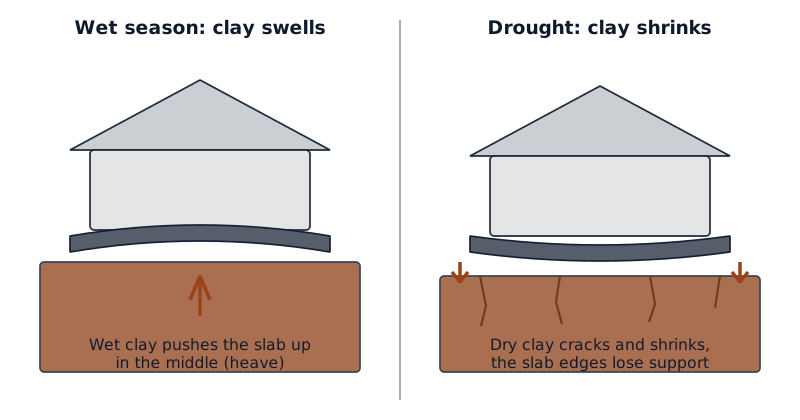
Houston soil conditions keep a house moving long after normal settling would have finished. Much of the area sits on heavy clay that swells when wet and shrinks when dry. The USDA describes the Lake Charles series, common in southeast Texas, as 45 to 60% clay that cracks half an inch to two inches wide and a foot or more deep in dry spells, with those cracks open 60 to 90 days in most years.
East of the Trinity River, the Beaumont clay is similar but poorly drained, so it stays wet longer. Either way, the soil around the edge of a slab dries and shrinks faster than the soil under the middle, which makes edges drop in summer and rise again in wet months.
Then there is land subsidence, which is separate from the clay. The USGS recorded more than 10 feet of subsidence near Pasadena between 1906 and 1995, and the Harris-Galveston Subsidence District now measures the fastest rates, over 3 cm a year, in the Katy and Fulshear area. Subsidence lowers whole areas fairly evenly, so on its own it rarely cracks one house, but it can change how a lot drains.
How can you check which one you have before calling anyone?
You can track it yourself for a few weeks with a pencil, a phone and a ruler. Mark each end of a crack with a short pencil line and the date, then photograph it next to a ruler. Check again every few weeks. If the crack grows past your marks, or new ones appear, the movement is active. If nothing changes through a dry spell and a wet one, it's likely settling.
A few more checks that cost nothing:
- Doors. Close each interior door and look at the gap along the top. A gap that is wider at one end shows the frame has racked.
- Floors. Set a marble or a small ball on hard floors in several rooms. One that rolls the same way every time is showing a slope.
- Outside. Walk the outside of the slab after rain. Note where water sits against the house and where the ground has pulled away from the concrete.
When should you have a professional look, and what does it cost?
Book a professional visit when the signs are growing, when several show up on one side of the house, when one edge of a crack sits higher than the other, or before you buy or sell. A foundation inspection in Houston averages about $600, with a range of $300 to $1,000, according to a 2026 Houston Press guide. That is small next to what late repair can cost.
| Item | Typical range | Source |
|---|---|---|
| Foundation inspection, Houston | $300 to $1,000 | Houston guide, 2026 |
| Structural engineer report | $500 to $1,000 | National guide, 2026 |
| Sealing a crack | $250 to $800 | National guide, 2026 |
| Typical Houston repair job | $3,300 to $6,800 | Houston guide, 2026 |
This Old House notes that a hairline crack sealed for $250 to $800 can turn into a $10,000 to $15,000 repair if the movement behind it is left alone. These figures are a guide, not a quote. The method depends on the house: most homes here are slab on grade, while older houses often need pier and beam foundation repair. Wider prices are on foundation repair cost in Houston. If you want a second set of eyes, we'll arrange a visit from a local foundation contractor, and you get a written quote before any work starts. Ask for a visit and a quote.
Questions people ask
How long does a house keep settling?
Most of a new house's settling usually happens in its first few years, as the soil under it compresses and the framing dries. After that it should slow to almost nothing. In Houston, seasonal clay movement can carry on for decades, so cracks that open in summer and close in winter are not settling that "hasn't finished". They are the soil responding to moisture, and drainage and watering matter more than age.
Can foundation problems fix themselves when it rains?
The signs can ease, but the cause stays. When rain returns after a drought, clay under the slab edge swells again, so cracks close and doors free up. The house has moved back, not been repaired, and the same movement usually returns with the next dry spell.
Should I worry about settling cracks before selling a house in Houston?
Yes, it pays to know what you have before a buyer's inspector tells you. A dated photo record of stable cracks helps show they are settling. If anything is growing, an inspection or an engineer's report gives you a written account of the condition, which buyers and lenders often ask for. Sellers of most previously occupied Texas homes also complete the disclosure notice required by Section 5.008 of the Texas Property Code, so knowing early helps.
What should I ask before hiring someone to check my foundation?
Ask what the visit includes: a full elevation survey with a level, or just a walk-around. Ask whether the report is written, whether it separates cosmetic cracks from structural movement, and whether the person inspecting also sells the repair. If they do, a separate engineer's report can be a useful check before you spend thousands on piers.
See foundation repair houston for the other services and what they cost.
Sources
- USDA NRCS, Lake Charles soil series description
- USDA NRCS, Beaumont soil series description
- USGS Fact Sheet 110-02, land subsidence in the Houston-Galveston region
- Harris-Galveston Subsidence District, 2025 annual groundwater report summary
- Houston Press, guide to foundation repair in Houston (2026)
- This Old House, foundation repair cost guide (October 2026)
- Texas Real Estate Commission, Seller's Disclosure Notice
Last changed