Normal foundation settling cracks are thin, mostly vertical lines that appear as a house eases onto the soil beneath it. They sit flush, they stay about the same width, and they usually turn up in predictable places: above door corners, at drywall seams, through a garage slab, or in a few mortar joints. They are cosmetic. In Houston they also tend to open a little in dry summers and close again in wet months, which is the clay, not a failing foundation. This page explains where settlement cracks form, how they behave, and how to patch them so the repair lasts. It belongs to our guide to foundation crack repair.
What are normal foundation settling cracks?
Normal settling cracks are the small breaks that form when a house and its foundation adjust to the ground under them. The soil compresses a little under the new weight, the framing dries out, and rigid finishes like drywall, tile and brick crack where they are weakest. The movement is small and fairly even across the house, so the cracks stay thin, straight or gently wandering, with no step from one side to the other.
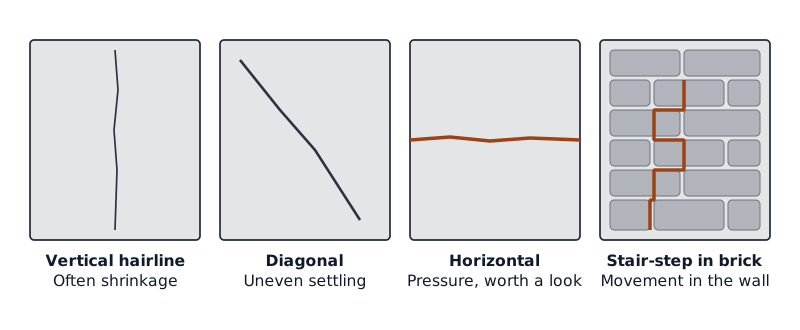
Shrinkage cracks form in the concrete itself as it cures and dries, often within the first couple of years, according to This Old House. Settlement cracks come from the whole structure moving slightly. Both are usually harmless. The pattern that should concern you is uneven movement, where one part of the house drops or lifts more than another. Engineers call that differential settlement, and it is what foundation settling repair is for.
This Old House also notes that vertical cracks are the ones most often linked with normal settling as a home adjusts. Diagonal cracks more often mean one part of the foundation moved differently from the rest, and horizontal cracks point to pressure from outside.
Where do settling cracks show up in a Houston house?
Settling cracks show up where a stiff finish meets a weak point: the corners of door and window openings, the joints between drywall sheets, the line where wall meets ceiling, the mortar in brick veneer, and the surface of a garage or patio slab. Most Houston homes sit on a slab or pier and beam, so basement wall cracks rarely apply.
| Where | What a normal settling crack looks like | What would not be normal |
|---|---|---|
| Drywall above doors and windows | A hairline running up from the corner, a few inches long | A long diagonal that keeps lengthening, or one that reopens soon after patching |
| Drywall seams and ceiling corners | A thin line along the tape joint | Seams opening on one side of the house only, with sticking doors nearby |
| Brick veneer | A few vertical hairlines in mortar joints | A widening stair-step pattern or bricks pushed out of line |
| Garage and patio slab | A thin line that sits flush on both sides | One edge higher than the other, or a gap you can fit a coin in |
| Interior tile over the slab | A single cracked tile or grout line | Cracks lining up across a room |
If you find something from the right-hand column, our guide on foundation cracks and when to worry walks through how to judge it.
Why do settling cracks open and close with Houston weather?
Settling cracks in Houston move with the seasons because the clay under most homes swells when wet and shrinks when dry. The USDA describes the Lake Charles clay, common across southeast Texas, as 45 to 60% clay that cracks 1/2 to 2 inches wide and a foot or more deep in dry spells. As that soil shrinks at the edge of a slab, the edge drops slightly, and finishes above it flex.
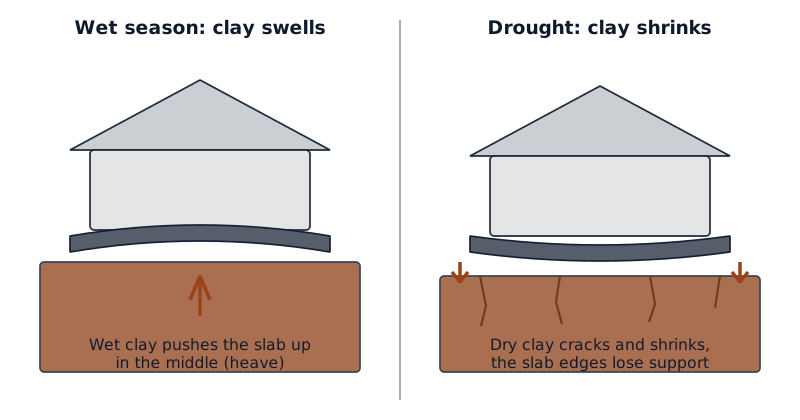
So a crack that was barely visible in March can look wider by late August, then close up again after a wet fall. The USDA notes those soil cracks stay open 60 to 90 days in most years. East of the Trinity River, the Beaumont clay drains poorly and stays wet longer, so the swing may be smaller but slower to settle.
A crack that opens in summer and closes in winter, back to the same width each year, is still in the normal range.
How do you repair normal settling cracks so they stay fixed?
Repair normal settling cracks with materials that can flex, and do it after you have watched the crack through at least one dry spell and one wet one. A crack that has held steady for a season is cosmetic, and patching it is ordinary decorating work. Rigid fillers in a crack that still breathes with the clay will simply crack again along the same line.
- Drywall. Cut out loose material, then bridge the crack with paper or mesh tape and joint compound, feathered wide. Our page on drywall cracks from settling goes through the method step by step.
- Ceiling and trim joints. Use a paintable flexible caulk where wall meets ceiling or trim meets wall. These joints move every season, so caulk outlasts compound there.
- Brick veneer mortar. A few hairline joints can be left alone or repointed with mortar that matches the original. Repointing a stair-step crack before the cause is known hides the evidence; see stair-step cracks in brick first.
- Garage and patio slabs. Clean the crack, then fill it with a flexible concrete crack sealant to keep water and debris out.
Paint over repairs only once the filler has fully cured. Photograph the patch with a ruler beside it and note the date.
How do you keep normal settling cracks from getting worse?
You keep normal settling cracks normal by keeping the moisture in the soil around the house as even as you can. Clay that stays at a steady moisture level moves far less than clay that swings between soaked and baked, so the cracks above it have less reason to grow.
- Water in drought. During long dry spells, even watering around the slab edge stops the soil pulling away. A soaker hose for your foundation is the usual way to do it.
- Move roof water away. Gutters and downspouts that empty a few feet from the house stop one corner flooding while the rest stays dry.
- Grade away from the slab. Soil should fall away from the house so rain does not pond against it. Standing water at the edge is a waterproofing and drainage problem as well as a movement one.
- Watch the trees. Large trees close to the house draw moisture from the clay unevenly in summer.
When does a settling crack stop being normal?
A settling crack stops being normal when it grows past where it was last year at the same time of year, when one side sits higher than the other, when it runs horizontally or in a long diagonal, or when it comes with doors that jam all year and floors you can see sloping. This Old House lists a crack wider than 1/4 inch among the signs a crack may be structural.
At that point a patch is the wrong answer: it hides the clue a contractor needs to read. Foundation repair itself, such as installing piers or shimming a pier and beam house, needs a building permit in the City of Houston: the city's weekly permit reports list foundation repair permits for homes every week. That work is for a foundation contractor, not a weekend project.
This Old House notes that a hairline crack sealed for $250 to $800 can become a $10,000 to $15,000 repair if the movement behind it is left alone. A foundation inspection is the usual first step when you are not sure which side of the line a crack falls on.
If you'd like a professional opinion, we'll arrange a visit from a local foundation contractor. They look at the cracks, check the floors for level, and explain whether anything needs doing. You get the price in writing before any work starts.
Questions people ask
How long does a house keep settling?
Most of the initial settling happens in the first few years after a house is built, as the soil compresses and the framing dries. In Houston, though, the clay keeps swelling and shrinking for the life of the house, so small seasonal movement never fully stops. That is why a stable crack that opens slightly every summer can still be normal on an older home.
Do settling cracks close up on their own?
Some do, partly. On Houston clay, a crack that opened during a dry summer often narrows again after a wet fall or winter as the soil swells back. It rarely disappears, because the finish has already broken. A crack that never narrows and gets a little wider each year is not following the seasons, and it is worth having someone look.
Should I fix settling cracks before selling my house?
Patching stable settling cracks before you list is normal decorating. Patching a crack that is still moving, so a buyer cannot see it, is a different matter. Texas sellers of most previously occupied homes must give buyers a disclosure notice on the property's physical condition, so keep any foundation inspection report and be ready to share it.
Can water get in through normal settling cracks?
Water can get in through any crack that reaches the outside, even a normal one. A thin crack in the exposed edge of a slab or in brick mortar can let moisture through, so seal it with a flexible sealant. Inside, a wet patch near a slab crack after rain usually means drainage around the house needs attention rather than the foundation itself.
Why don't my cracks look like the basement pictures online?
Most online crack photos come from basement walls, and Houston has almost no basements. Here you are looking at a slab on grade or a pier and beam house, so settlement cracks show in drywall, brick veneer, tile and the garage slab instead.
This guide is one of many on foundation repair in Houston.
Sources
- This Old House, foundation cracks: what is normal and when to worry (April 2026)
- This Old House, foundation repair cost guide (October 2026)
- USDA NRCS, Lake Charles soil series description
- USDA NRCS, Beaumont soil series description
- Texas Real Estate Commission, Seller's Disclosure Notice
- City of Houston weekly building permit report, July 2024
Last changed