Stair step cracks in brick are cracks that climb diagonally through the mortar joints, one course at a time, like a staircase. On a Houston home they usually mean part of the slab under that wall has settled or heaved, because the Brick Industry Association links stepped cracking directly above a foundation to foundation movement. The brick is showing you where the slab moved. This page goes deeper than our foundation crack repair overview: how to read the shape of a stepped crack, how to track it through the seasons, and the order the repair follows.
What do stair step cracks in brick mean?
A stair step crack in brick means the wall has been pulled or bent by uneven support from below. Mortar is weaker than brick, so the crack follows the joints in steps instead of breaking the units. The Brick Industry Association's note on movement says unstable or expansive soils often cause differential settlement in foundations, and that this can produce diagonal or stepped cracking in the brickwork directly above.
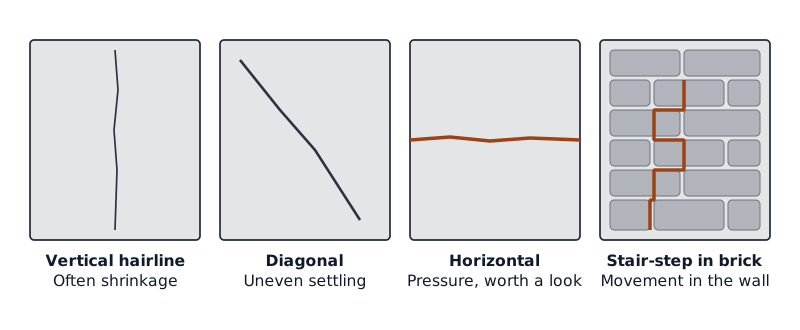
On most Houston houses the brick is veneer: a single outer layer tied to the wood frame and resting on the slab edge. It carries no load for the house, but it records slab movement honestly.
Fine vertical cracks near corners are usually brick expansion instead, covered in vertical hairline cracks in brick veneer. General mortar and brick repair is in cracks in brick walls.
How do you read which part of the slab moved?
You read a stair step crack by its taper, its direction and where it sits on the wall. The Brick Industry Association says settlement cracks are identified by a tapering shape, so the crack is wider at one end. The wide end and the side of the crack that sits lower point toward the part of the foundation that moved most. A floor level survey inside the house confirms it.
Treat these as clues, not a diagnosis:
| What you see | What it often points to |
|---|---|
| Steps climbing up toward a corner, widest near the top | That corner of the slab has dropped |
| Cracks on both sides of a wall, widest near the top in the middle | The middle of the slab is higher than the ends, a common pattern on clay |
| Crack widest near the bottom | The ends of the wall are higher than the middle |
| Steps starting at the corner of a window or door | Movement concentrated at the weakest point of the wall |
| One side of the crack sticking out past the other | Movement out of the wall's plane, worth an engineer's look |
Then walk inside. Doors that stick or swing on their own, gaps over door frames, and diagonal drywall cracks on the same side as the brick crack all point to the same movement.
Are stair step cracks in brick serious?
Stair step cracks in brick are worth taking seriously, but not every one means a large repair. The Brick Industry Association lists cracks wider than 0.075 inch (2 mm), cracks running through several bricks, and cracks following a stepped or diagonal pattern as signs of a structural issue rather than routine maintenance. It says those usually call for investigation by a professional engineer to find the cause.
What tips a stepped crack from "watch it" to "get it checked":
- Width. Wider than about 2 mm (0.075 inch).
- Growth. It gets longer or wider between checks.
- Broken bricks. The crack cuts through bricks instead of only following mortar.
- Offset. One side sits proud of the other.
- Company. Sloping floors, sticking doors or gaps at window frames on the same side.
How do you track a stair step crack through a Houston year?
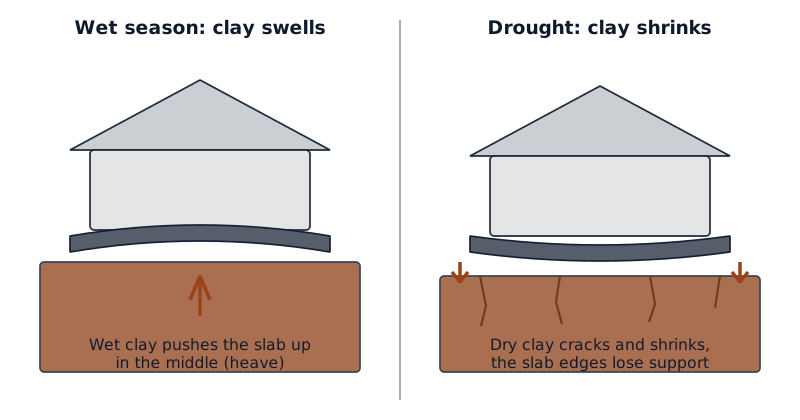
Track a stair step crack by measuring it at the same points every few weeks for a full year, because Houston clay moves with the seasons. The USDA describes Lake Charles clay, common across the area, as 45 to 60% clay that cracks 1/2 to 2 inches wide at the surface in dry spells. A brick crack can open in a dry summer and partly close after a wet winter.
A simple routine:
- Mark both ends of the crack in pencil with the date, so you can see if it grows longer.
- Pick three spots along it, at the top, middle and bottom, and mark them.
- Photograph each spot beside a ruler or a crack width card, square to the wall, from the same distance.
- Write down the weather that week: long dry spell, or after heavy rain.
- Repeat every two to four weeks. A crack that only breathes with the seasons points to moisture swings in the soil. A crack that grows a little more each year points to ongoing settlement.
Seasonal movement is often driven by water, so the fix may include drainage work around the slab. If the crack is growing fast, don't wait out the year.
Are stair step foundation cracks in block walls the same?
Stair step foundation cracks in concrete block walls follow the same rule: the mortar joints give way in steps when part of the wall loses support. In much of the country they show up in a basement wall, where soil pressure and moisture also play a part. Houston has almost no basements, so here a stepped crack in block is more often in a garage wall, a block pier or a retaining wall.
Read it the same way as brick: taper, direction, and any offset. Bowing in a wall that holds back soil is a different problem, covered with block repairs in cracks in concrete block walls.
How are stair step cracks in brick repaired?
Stair step cracks in brick are repaired in two stages: first the movement, then the masonry. If the slab is still settling, a contractor installs piers under the part that dropped to support and lift it, which is a form of underpinning. If the cause is seasonal moisture, drainage and soil moisture work come first. Only once the slab is stable does a mason repoint the joints.
The usual order:
- Level survey and inspection. A contractor measures the floor and looks at the slab edge, drainage, trees and any plumbing leaks.
- Fix the cause. Piers under the dropped section, drainage changes, or both. See foundation piers for how the main pier types differ.
- Lift where possible. Lifting the slab can close a stepped crack part of the way. It rarely closes it completely.
- Repoint the brick. Cut out the cracked mortar and pack new mortar into the joints. Replace any bricks the crack broke through.
- Check the weeps and seals at the base of the wall and around windows, so water keeps draining out of the wall.
Don't leave a wide crack open for years, though. The Brick Industry Association notes veneer walls can manage some extra moisture through minor cracks, but a wide stepped crack lets more rain reach the frame behind.
As a guide, sealing a crack runs about $250 to $800 nationally, while most Houston foundation repairs with piers fall between $3,300 and $6,800. The full breakdown is in foundation crack repair cost.
When should you call a foundation contractor about a stair step crack?
Call a foundation contractor when a stair step crack is wider than about 2 mm, grows between your checks, breaks through bricks, has one side offset, or shows up with sticking doors or sloping floors inside. Call too if a mason has repointed it once and it reopened. Those signs say the slab is still moving, and brick repair alone won't hold.
A visit means a contractor walks the outside, measures the crack, runs a floor level survey and looks at drainage around the house. The price for any work comes to you in writing before anything starts. If the cause isn't clear, or you are buying or selling, a structural engineer's foundation report gives you an independent view.
Inside the City of Houston, foundation repair needs a building permit, and one week of the city's permit reports in July 2024 listed 23 of them. Cities around Houston set their own rules, so check with the building department in places like Sugar Land before work starts.
If your brick has a crack climbing through the mortar, we'll arrange a visit from a local foundation contractor to measure it and the floors: request a written foundation quote.
Questions people ask
Can a stair step crack in brick be normal settling?
Sometimes. Many houses settle a little in their first years, and a narrow stepped crack that has not changed in a long time may be from that. The only way to know it has stopped is to measure it over time and have the floor level checked. A crack that grows, tapers wide, or comes with sticking doors is active movement, not normal settling.
Should I fill a stair step crack in brick myself?
Not before the cause is known. Filling a stepped crack hides the taper and width a contractor needs to read the movement, and new mortar over a moving slab simply cracks again. If the slab is confirmed stable and the crack is narrow, repointing those joints is reasonable masonry work. Use a soft mortar and keep the weeps at the base of the wall clear.
Will a stair step crack close after foundation repair?
Often partly, not fully. When a contractor lifts the dropped section on piers, the brick above can move back toward its old position and the crack narrows. Mortar debris and the brick's own movement usually stop it closing completely. That is why the brick is repointed after the lift, not before, so the new mortar sits in joints that are no longer moving.
Are horizontal cracks in brick worse than stair step cracks?
They point to a different problem. A stair step crack in brick usually comes from the slab settling or heaving unevenly. A horizontal crack in brick veneer can come from failed wall ties or a sagging lintel or shelf angle. Either deserves a professional look if it is wide or growing.
For the wider picture, start with Foundation Repairs Houston Quotes.
Sources
- Brick Industry Association, Technical Note 18, Volume Changes: Analysis and Effects of Movement
- Brick Industry Association, Technical Note 46, Maintenance of Brick Masonry
- USDA NRCS, Lake Charles soil series description
- This Old House, foundation repair cost guide (October 2026)
- Houston Press, guide to foundation repair in Houston (2026)
- City of Houston weekly building permit report, July 2024
Last changed