A vertical hairline crack in brick veneer is usually the brick itself growing, not the house sinking. Fired brick swells slowly and permanently as it takes on moisture, and where a wall has no room to move, it splits in a straight vertical line, often near a corner or a window. A crack that stays the same width top to bottom and stays in the mortar is mostly a cosmetic and water question. A crack that tapers, runs through bricks or keeps growing points to the slab, and that belongs with foundation crack repair in Houston. This guide covers how to tell which one you have and how each gets fixed.
What do vertical hairline cracks in brick veneer mean?
In most Houston homes, a vertical hairline crack in the brick means the veneer ran out of room to expand. The Brick Industry Association says brick is the only building material that undergoes irreversible moisture expansion, so a long run of brick keeps pushing until something gives. Because veneer is a skin tied to the wood frame and does not carry the house, one fine, even crack is rarely a structural problem on its own.
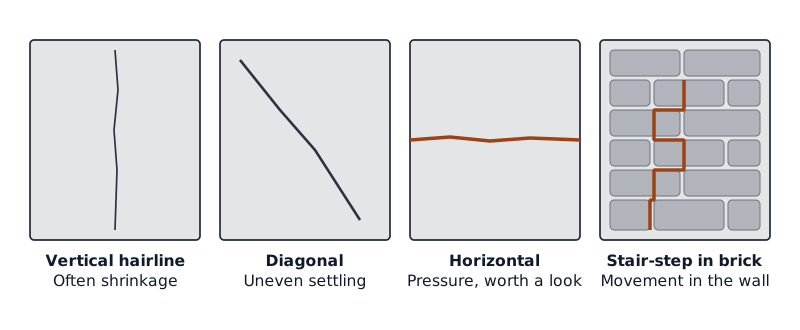
"Hairline" means you can see the line but can't fit a fingernail in it. At that size, in one spot, the usual causes are:
- Brick expansion at a corner, an offset in the wall, or a long wall with no soft joint.
- Mortar shrinkage, as the mortar dries after the house is built. The Brick Industry Association notes it partly offsets the brick's growth.
- Brick bonded to the slab, where the brick grows and the concrete under it shrinks, so the bottom courses crack near a slab corner.
Diagonal and stepped lines are the patterns linked to settlement, covered in stair-step cracks in brick.
Why do vertical cracks form in brick veneer on Houston homes?
Vertical cracks form where the expanding brick meets resistance. The Brick Industry Association recommends vertical expansion joints no more than 25 feet apart in brick without openings and 20 feet apart where there are several windows or doors, plus joints near corners and at offsets. Many tract homes have long brick runs with few or no such joints, so the wall makes its own joint by cracking.
Where to look:
| Where the crack is | What usually causes it | Typical look |
|---|---|---|
| At a corner, one brick in on one side | Two walls expanding toward the same corner | Straight line up the first vertical mortar joint |
| At an inside corner or where the wall steps out | The offset rotating as both walls push | Vertical crack at the step, sometimes the brick slightly out of line |
| Halfway along a long, plain wall | No expansion joint in a run longer than about 25 ft | Even-width line, often through mortar and some bricks |
| Under or over a window | Brick above and below the window moving more than the brick beside it | Line running from the corner of the opening |
| In the bottom few courses near a slab corner | Brick bonded to concrete, brick growing, slab shrinking | Short crack at the base, brick nudged past the slab edge |
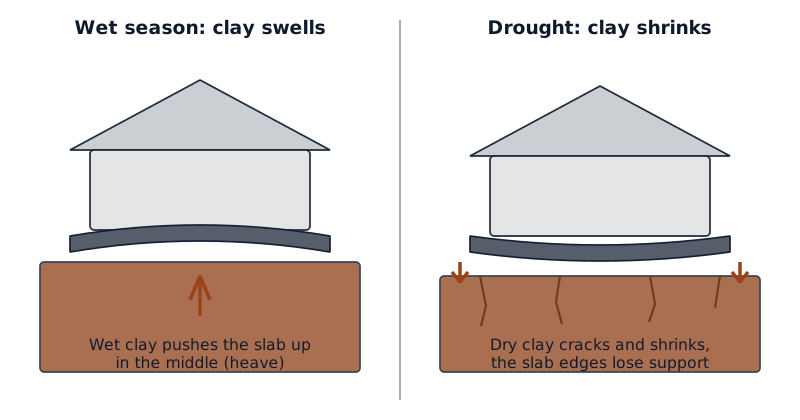
Houston adds soil movement. The USDA describes Lake Charles clay, common across southeast Texas, as 45 to 60% clay that cracks 1/2 to 2 inches wide in dry spells. When it shrinks under one slab corner, the brick above cracks in a different way.
How can you tell a brick expansion crack from a foundation crack?
The shape gives it away. The Brick Industry Association identifies settlement and deflection cracks by their tapering shape: wide at one end, narrowing to nothing. An expansion crack tends to stay about the same width along its length and sits where the wall had no room to move. A settlement crack tapers, often wanders into a stepped line, and lines up with a part of the slab that has dropped or lifted.
Check these on the wall:
- Width along the length. Even from top to bottom points to expansion. Wider at the top or at the bottom points to movement below.
- Path. A straight line in one head joint is typical of expansion. A crack that steps through the bed joints, or turns diagonal partway up, follows settlement.
- Offset. Run a finger across it. If one side sits proud of the other, the wall has moved out of plane.
- Through the brick. The Brick Industry Association lists cracks through several bricks among the conditions it treats as structural.
- Inside the same wall. Doors that now stick, a gap at the top of a door frame or new drywall cracks on that side of the house suggest the slab is moving. The guide to sticking doors explains what those signs mean.
If even one check says taper, offset or interior movement, have the slab looked at before anyone touches the brick. Crack direction more broadly is covered in vertical vs horizontal foundation cracks.
How do you measure and monitor a hairline crack in brick?
Measure the width at its widest point, mark both ends with the date, and photograph it beside a ruler from the same spot every few weeks. The Brick Industry Association treats cracks wider than 0.075 inch (2 mm) as structural, so that is the number to compare against. A crack that stays hairline and doesn't lengthen over a full Houston summer is almost always stable.
- Use a reference. A plastic crack-width card or a ruler with millimeter marks.
- Measure top, middle and bottom. A growing difference between them shows taper.
- Mark both tips with a short pencil line and the date.
- Photograph it square on, ruler in frame, from a spot you can find again.
- Repeat monthly, including the end of the dry season and after a wet spell, when the clay is most shrunk and most swollen.
Don't fill the crack while you're watching it. A patch hides the very evidence a contractor needs to see.
Do hairline cracks in brick veneer let moisture into the wall?
A little, and the wall is built to cope with that. The Brick Industry Association notes that veneer walls can manage the extra moisture that comes through minor cracks, because water that passes the brick runs down the air space behind it and out through the weeps at the base. The real risk is when those weeps are blocked or the flashing behind them has failed.
Water behind veneer in Houston doesn't end up in a basement, because almost no homes here have one. It reaches the sheathing, the bottom of the wood frame and the slab edge instead. So:
- Keep the weeps open. The small gaps in the bottom course of brick must stay clear of soil, mulch and paint.
- Skip the clear sealer. The Brick Industry Association says water repellents are generally not recommended on new brick veneer, and they never replace flashing and weeps. A spray-on waterproofing coat is not a crack repair.
- Watch inside. A damp baseboard on the same wall means water is getting past the air space, and the repair is no longer cosmetic.
How are vertical hairline cracks in brick veneer repaired?
The repair depends on the cause. A fine crack in a few mortar joints can be face grouted or repointed. A crack caused by brick expansion needs a proper expansion joint, because new mortar in that spot simply cracks again. A crack caused by slab movement waits until the foundation is stable, then gets repointed. Brick repair over an active foundation is wasted money.
The three repairs in practice:
Face grouting. For true hairline cracks in mortar, the Brick Industry Association describes brushing a fluid cement, lime and fine sand grout into the dampened joint with a stiff fiber brush, usually in two coats, then tooling it. It works but changes the look: the joint comes out slightly wider and smoother.
Repointing. For cracked or weathered mortar, the joint is raked out and refilled with a mortar no stronger than the original. The full step-by-step is on the cracks in brick walls guide, so it isn't repeated here.
A new expansion joint. For a recurring corner or long-wall crack, a mason saw-cuts a clean vertical joint through the brick, keeping mortar and ties from bridging it, then fills it with a backer rod and an elastomeric sealant. The Brick Industry Association recommends a backer rod about 25% wider than the joint and a sealant about half as deep as the joint is wide. The joint should sit within about 2 feet of a corner where possible.
When should a foundation contractor look at a vertical crack in brick?
Call a foundation contractor when the crack tapers, has one side offset, runs through several bricks, grows between your pencil marks, or comes back after it has been repointed. The same goes when the crack appears with sticking doors or sloping floors on that side of the house. Those signs mean the slab is moving, and the brick is only reporting it.
A contractor checks the slab for level and the drainage near that corner, and says whether the crack is stable or needs piers. Inside the City of Houston, foundation repair needs a building permit, which the contractor normally pulls. If you want an independent view first, a foundation inspection sets out what's wrong before anyone prices a fix.
If your vertical crack fails any of the checks above, we'll arrange a visit from a local foundation contractor. You get a written estimate, covering what they found and the repair they suggest, before any work starts: request a foundation quote.
Questions people ask
Are vertical hairline cracks in brick normal on a newer house?
Fairly common, yes. New brick takes on moisture and grows while new mortar dries and shrinks, so a newer house can show a fine vertical crack at a corner or beside a window within a few seasons. If it stays hairline and even, it is usually expansion. Record it, keep watching it, and have the builder look while any new-home warranty still applies.
Should I caulk a vertical crack in brick veneer?
Not over ordinary mortar. Caulk in a mortar joint looks patched and splits as the wall moves. Sealant belongs in a purpose-cut expansion joint over a backer rod, and around window and door frames. For an expansion crack, ask a mason about a proper joint. For slab movement, leave it until the foundation is checked.
Are horizontal cracks in brick veneer worse than vertical ones?
Often, yes. A vertical hairline crack is usually the brick expanding. Horizontal cracks in veneer can mean the slab edge is moving, a lintel is sagging, or the brick is pulling away from its ties, and any of those needs a closer look. With no basements here, the classic horizontal basement-wall crack from soil pressure isn't the Houston pattern. Brick and slab movement is.
Will a vertical hairline crack in brick get bigger?
An expansion crack often settles at a steady width, though it can open and close slightly with heat and moisture. A crack that keeps widening is behaving like settlement. The only way to know is to measure it: mark the ends, record the width at three points, and compare over a few months, including one dry spell.
Do I need a permit to repair a crack in brick veneer in Houston?
Repointing or grouting a few joints is maintenance, but check with the City of Houston permitting office if you're unsure about your job. Foundation repair inside the City of Houston needs a building permit, and its weekly permit reports list them by the dozen. If the brick repair follows slab work, the foundation contractor normally handles the permit.
The rest of our guides start from Foundation Repairs Houston Quotes.
Sources
- Brick Industry Association, Technical Note 18, Volume Changes: Analysis and Effects of Movement (2019)
- Brick Industry Association, Technical Note 18A, Accommodating Expansion of Brickwork (2019)
- Brick Industry Association, Technical Note 46, Maintenance of Brick Masonry
- USDA NRCS, Lake Charles soil series description
- City of Houston weekly building permit report, July 2024
Last changed