Fix drywall cracks from settling in the right order: first make sure the house has stopped moving, then repair the crack with a strong compound and tape, not a dab of spackle. A crack patched while the slab is still shifting will open again along the same line, usually within a season. If the movement keeps going, the cracks are a symptom, and the real repair is under the floor. This guide covers how to confirm a crack comes from settling, how long to wait, the repair steps that hold, and what changes after foundation work. For cracks in the concrete itself, start with our foundation crack repair guide.
How do you know a drywall crack is from settling?
A drywall crack from settling usually runs at an angle from the corner of a door or window, shows up on one side of the house more than the other, and changes over time. Cracks caused by drying lumber tend to follow seams or pop over screws and then stay put. The test is movement: a crack that widens, lengthens or reappears after a repair is following the structure, not the paint.
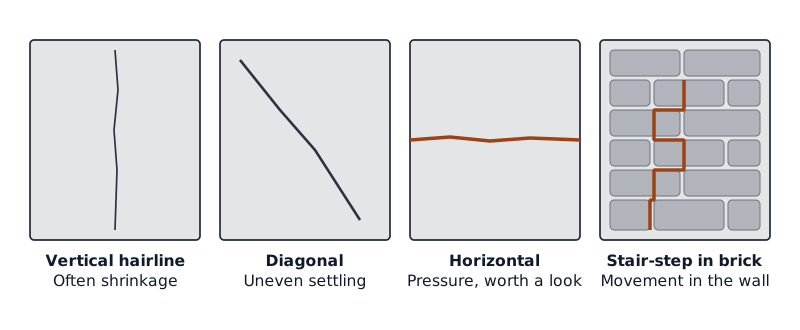
Look nearby for a door that rubs at one top corner or a baseboard with a gap at one end. The NDSU Extension engineer Ken Hellevang links cracks in walls and ceilings, along with sticking doors and windows, to soil shrinking and the building shifting.
The quickest way to tell is a crack log. Mark both ends of the crack in pencil with the date, photograph it beside a ruler, and check it on the same day every month.
| What you see after a few months | What it most likely means | What to do |
|---|---|---|
| No change at all | Old movement, or lumber shrinkage that has finished | Repair it now |
| Opens in dry spells, closes after rain | Clay soil under the slab swelling and shrinking | Repair in a stable season, then watch |
| Grows steadily in one direction | The house is still settling on that side | Have the foundation checked before patching |
| One edge sits proud of the other | The wall frame has racked or twisted | Stop patching and get an inspection |
What each crack shape usually means is covered in cracks in sheetrock walls.
Should you wait before fixing drywall cracks from settling?
Yes, in most cases. Hellevang's advice for shrink-related wall cracks is to wait until soil moisture returns to normal, because a repair made earlier can be pulled apart by further movement. In Houston, that means patching after the soil has settled into a steady pattern, not in the middle of a long dry spell or right after a week of heavy rain.
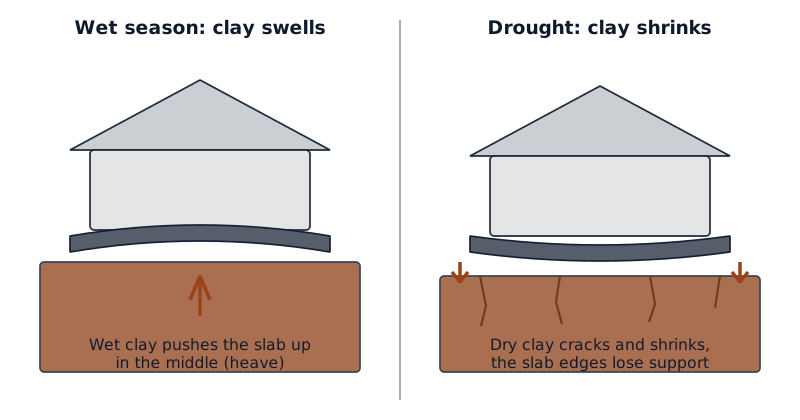
Houston's clay is the reason the wait matters. The USDA describes Lake Charles clay, common across southeast Texas, as 45 to 60% clay that opens surface cracks 1/2 to 2 inches wide when dry, with the cracks staying open 60 to 90 days in most years. As that soil dries and rewets, a slab edge can drop and rise, and the drywall above it flexes with it.
A practical rule: keep the crack log running through one full dry season. No growth across that stretch means the crack is ready to repair.
How do you repair drywall settling cracks so they stay closed?
Repair a settling crack by cutting it open, filling it with setting-type joint compound, bridging it with fiberglass mesh tape, and feathering several thin coats well past the edges. Setting-type compound hardens by chemical reaction and is stronger than premixed. Mesh tape, which This Old House favors for crack repairs, resists moisture and embeds fully. Prime and paint the whole patch area.
These steps are for a crack that has stopped moving. Choosing a filler for small cracks is covered in our guide to filler for cracks in walls.
- Check that both sides are flush. Run a straightedge across the crack. If one edge stands higher, the board has shifted. Drive drywall screws into the stud or header on the high side to pull it back to the frame before you fill.
- Look for loose board. Press gently either side of the crack. A panel that flexes or crunches has broken away from its fasteners and needs new screws, or that section cut out and replaced.
- Open the crack into a V with a utility knife or a multi-tool hook, and brush out every crumb. This Old House notes that loose debris bonds poorly and leads to cracking again.
- Fill with setting-type compound. It comes as a powder you mix with water just before use. Press it into the V with a 6-inch knife and let it harden.
- Bed mesh tape across the full length, running a few inches past each end of the crack, where the stress continues even if the crack does not yet show.
- Feather thin coats. Apply two or three coats, each wider than the last, and sand lightly between them. A single heavy coat only makes a bulge.
- Prime, then paint the whole wall section so the patch does not show as a dull band.
Older homes with plaster on lath, common in the Heights, need a different approach, covered in our page on cracks in plaster walls.
What happens to drywall cracks after foundation leveling?
After a foundation lift, some old drywall cracks close, some get wider, and a few new ones can appear as the frame adjusts to the new level. That is normal, and it is why contractors often suggest leaving drywall work until after the slab is lifted. Give the house a few weeks to a few months to finish adjusting, then repair every crack in one round.
During foundation leveling, the low part of the house is lifted back toward level and racked walls straighten. A crack that was wide can pinch shut, while a hairline crack on the opposite wall can open as the stress moves.
Photograph every crack with the date before the work starts, then compare after the lift, so you know what the leveling changed.
Who fixes the drywall after foundation repair, and what does it cost?
A foundation repair quote covers the work on the slab or the piers, and it may or may not include the drywall, paint and trim inside. Ask before you sign whether interior patching is included, and if not, plan to have a drywall finisher or handyman do it once the house has adjusted. The price for the foundation work comes in writing before any work starts.
For the foundation side, the Houston Press guide puts most Houston foundation repair jobs at about $3,300 to $6,800, with inspections around $300 to $1,000, and notes that interior work adds roughly 15% to a job. In the City of Houston, foundation repair needs a building permit, and the city's weekly permit reports list these jobs regularly.
Not sure the cracks need foundation work at all? Start with a foundation inspection. We'll arrange a visit from a local foundation contractor, who takes floor elevation readings and gives you a written price before anything is done.
When are drywall cracks from settling a sign of something serious?
Drywall cracks from settling become serious when they keep growing after a careful repair, spread across several rooms on one side of the house, open wider than about 1/4 inch, or come with doors that suddenly stop latching and floors that tilt. This Old House lists a crack wider than 1/4 inch and doors or windows that stop working as signs of a structural problem.
Hairline cracks that appear once and stay the same size are rarely a concern. What matters is change over time.
Horizontal cracks worry people because elsewhere they can mean soil pushing on a basement wall. Houston homes rarely have a basement, so a horizontal drywall crack here usually follows a seam. Also rule out moisture: staining or soft board around a crack points to a leak, and waterproofing or plumbing comes first.
Questions people ask
How long does it take to repair drywall settling cracks?
The hands-on work is usually a few hours spread across two or three days, because each coat of compound has to harden or dry before the next. The longer part is the wait before you start. Keep a crack log for at least one dry season, or wait a few weeks to a few months after any foundation leveling, so you only repair the crack once.
Can I just caulk drywall cracks from settling?
Caulk flexes, so it can hide a moving crack for a while, but it does not paint or sand like the wall around it and usually shows. It suits joints where drywall meets trim or a door casing. On a flat wall, a settling crack that has stopped moving is better repaired with compound and mesh tape.
Do drywall settling cracks mean my foundation is failing?
Not on their own. Many houses show a few drywall cracks from small, harmless movement and from framing lumber drying out. The foundation is more likely involved when the cracks grow, cluster on one side, and arrive with sticking doors or sloping floors. A crack log and a look at the doors near each crack usually tell you which group yours belong to.
Why do drywall cracks from settling come back in summer?
Because the soil under the house dries out. Clay shrinks as it loses moisture, and in Houston long dry summers can let one edge of the slab drop slightly, which opens cracks along the same lines as before. A crack that follows that cycle is a sign the soil moisture around the slab needs attention.
Do I need a permit to fix drywall cracks from settling?
Patching drywall cracks yourself is cosmetic work. The foundation repair behind them is not: in the City of Houston, foundation repair needs a building permit, and some nearby cities, such as Bellaire, have their own permit rules. A foundation contractor normally handles the permit as part of the job. Check with your city before any structural work starts.
This guide is one of many on the foundation repair guide for Houston.
Sources
- NDSU Extension, Ken Hellevang, dry soil may cause building problems (2017)
- National Research Council Canada, Canadian Building Digest 244, Effects of Wood Shrinkage in Buildings
- This Old House, how to patch cracked drywall
- This Old House, foundation cracks: what is normal and when to worry
- USDA NRCS, Lake Charles soil series description
- Houston Press, guide to foundation repair in Houston (2026)
- City of Houston weekly building permit report, July 2024
Last changed