Most cracks in sheetrock walls are cosmetic. They follow a taped seam, sit over a screw, or run a short way from the top corner of a door, and they come from framing lumber shrinking or the house adjusting to humidity. A smaller group point to the slab moving: cracks that widen month after month, run diagonally from several openings on one side of the house, or arrive with doors that start to bind. This guide shows how to read each pattern and fix the cosmetic ones so they stay fixed. For cracks in the concrete itself, see our foundation crack repair guide.
Are cracks in sheetrock walls a sign of foundation problems?
Sometimes, but less often than people fear. Sheetrock is a stiff gypsum panel fastened to wood framing, so it cracks at its weak points whenever anything behind it moves, including lumber drying out after construction. Cracks become a sign of foundation movement when they keep growing, cluster on one side of the house, show a gap wider at one end than the other, or appear alongside sticking doors and sloping floors.
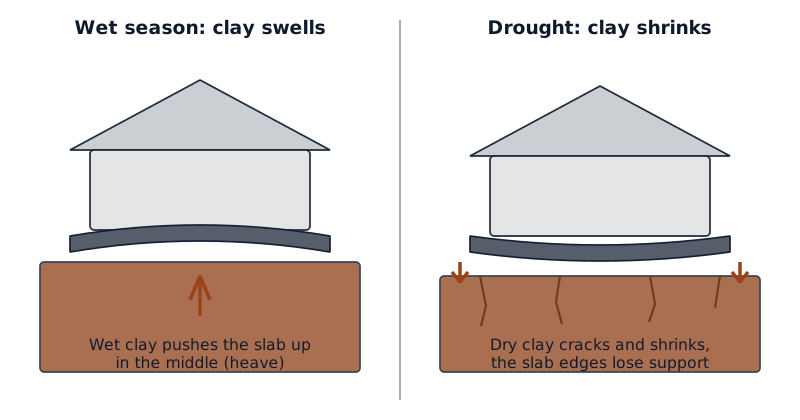
Houston gives you a local reason to look closer. Lake Charles clay, the heavy soil under much of the area, is mostly clay by USDA measure and opens wide surface cracks in dry weather. A slab edge on that soil can drop in a drought, and the sheetrock shows it first.
What do the different crack patterns in sheetrock mean?
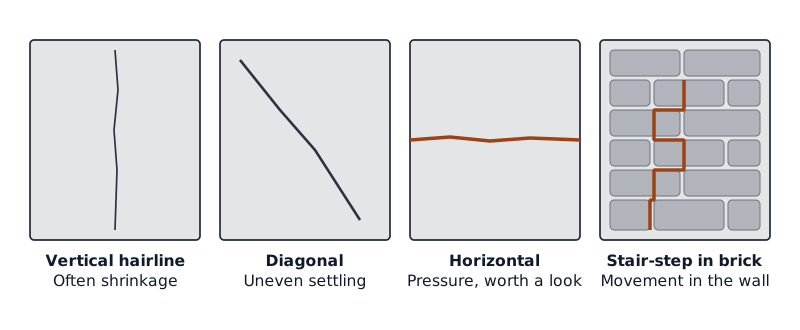
The position and direction of a crack usually tell you its cause. Straight cracks along seams and small round bumps over fasteners come from the framing. Cracks at the ceiling line of interior walls often come from the roof framing. Diagonal cracks from the corners of doors and windows are the ones most linked to the foundation, especially when they grow or repeat across one side of the house.
| Where the crack is | What it usually means | What to do |
|---|---|---|
| Straight line along a taped seam | Joint tape lifting from shrinking framing or a thin first coat | Cut out the loose tape and re-tape |
| Small round bumps or circles over screws or nails | Fastener heads pushed out as the wood dried | Reset with new screws beside the old ones |
| Short diagonal from the top corner of a door or window, under 1/16 inch | Header lumber shrinking, often in the first years | Re-tape once and watch it |
| Diagonal from several openings on one wall, widening | Part of the slab settling or heaving | Have the foundation checked before patching |
| Gap where an interior wall meets the ceiling | Roof framing lifting or settling | Float the corner rather than fill it |
| Vertical crack in an inside corner | Framing at the corner shrinking unevenly | Re-tape with a flexible corner method |
| Horizontal crack across the middle of a wall | Usually a horizontal seam; sometimes framing movement | Check whether it lines up with a sheet joint |
Photograph each crack beside a tape measure and date the photo. A few months of photos say more than any single look.
Why does sheetrock crack in Houston homes?
Sheetrock cracks for three main reasons: the wood behind it shrinks, the house moves with seasonal moisture, and on Houston clay, the slab can shift. Research by the National Research Council of Canada found that drying lumber pulls fasteners partly out of the framing, leaving a gap behind the board that later shows as nail pops. Cracks around doors and windows follow uneven shrinkage at headers.
Wood shrinks far more across its width than its length, the Building Science Corporation notes, so thick headers and three-stud corners are where cracks gather.
Roof framing adds another pattern. When the top and bottom of a roof truss hold different amounts of moisture, the truss can arch and lift the ceiling off interior walls. It is better known in cold climates, so treat it as one possibility, not the default, in a Houston attic.
The foundation is the third cause. Many Houston homes sit on a slab on clay, and older homes in areas like the Houston Heights sit on pier and beam. On either, uneven soil moisture under one side of the house can tilt the floor enough to rack the wall frames above it.
How do you fix cracks in sheetrock walls?
Fix a sheetrock crack by treating its cause, not just its surface. Re-tape a seam crack after cutting out the loose tape. Reset popped fasteners with new screws an inch or two away, then cover both. Float a ceiling corner crack instead of filling it rigidly. Patch doorway diagonals only once the house has stopped moving.
- Seam cracks. Score along both edges of the lifted tape with a utility knife and peel it out. Apply new tape and compound in thin coats. This Old House recommends fiberglass mesh tape for crack repairs because it is not affected by moisture.
- Nail pops. Do not hammer the old nail back in. Drive a drywall screw just above and below it to pull the panel tight to the stud, then set the old head slightly below the surface and cover all three.
- Ceiling line gaps. A hard filler here tears again as the framing moves. Builders deal with this by leaving the ceiling board unfastened near the wall so the joint can flex, or by covering the joint with a trim molding fixed to the ceiling only, as the NRC digest describes.
- Doorway diagonals. Cut a shallow V, fill, tape across the crack, and feather wide. If it reopens along the same line within a season, stop patching.
- Damaged or soft board. Sheetrock that has crumbled, swollen or stained from moisture needs a section cut out and replaced, after the leak is fixed.
Which compound and tape suits each job, with full step-by-step instructions, is covered in our guide to filler for cracks in walls.
How do you check whether a sheetrock crack comes from the slab?
Walk the house with the crack in mind and look for the same movement elsewhere. Check that doors near the crack close and latch without rubbing, look for brick cracks on the outside of the same wall, roll a marble or use a level on the floor below it, and look at baseboards for gaps. If two or more of these line up with the crack, the slab is the likely cause.
- Doors. Look at the gap between the door and frame. A gap wider at one top corner than the other is a sign the frame has racked. Our page on doors sticking explains how to read that.
- Outside walls. Stair-step cracks in brick on the same side as the inside crack point to that side of the slab moving.
- Floors. A 4-foot level on hard flooring near the crack shows any slope.
- Seasons. Cracks that open in long dry spells and close after heavy rain follow the clay under the house.
For the wider list of symptoms, see the signs of foundation problems.
When should you call a foundation contractor instead of patching?
Call a foundation contractor when a sheetrock crack widens after you repair it, when several openings on one side of the house crack at once, when one edge of the crack sits proud of the other, or when doors and floors near it have changed. Those are serious signs the frame is being pushed by the slab, and no amount of compound will hold.
The usual first step is a foundation inspection, with floor elevation readings and a look at the slab edge and drainage. The Houston Press puts inspections in Houston at about $300 to $1,000 and most foundation repair jobs at $3,300 to $6,800. In the City of Houston, foundation repair needs a building permit, and the city's weekly permit reports list them regularly.
Leave the sheetrock until any foundation work is done. Lifting a slab can open new cracks and close some old ones, so a contractor will usually suggest patching walls last. Whether your house has normal movement or a real problem is covered in foundation problems vs settling.
If the cracks you see are thinner than a pencil line, our guide to hairline cracks in walls covers why they form and how to hide them so they stay gone.
Questions people ask
Are horizontal cracks in sheetrock walls serious?
Usually not on their own. Most horizontal cracks in a Houston wall follow a joint between two sheets hung on their side. Horizontal cracks in a basement wall are a different matter, because soil presses on it, but Houston homes almost never have a basement. If a horizontal crack does not line up with a sheet joint, grows, or sits above a sagging floor, have it checked.
Can moisture cause cracks in sheetrock walls?
Yes. Framing lumber swells and shrinks as indoor humidity changes, and that movement opens seams and pops fasteners. A leak is worse: wet gypsum softens and loses strength, and the crack shows where the board is failing. Fix the water source first, let the wall dry fully, then replace any soft board. Waterproofing the outside of the slab does not fix an indoor leak.
Why does the crack above my door keep coming back?
Because something is still moving. A header that is still drying out can reopen a patch for a year or two, then settle down. A crack that returns year after year, or gets wider each time, more often means the wall frame is being racked by the floor. Check whether the door has also started to rub before you patch again.
Are hairline cracks in sheetrock normal in a new house?
Yes, hairline cracks are common in the first year or two of a new house. Fresh framing lumber dries and shrinks after the house is closed in and the air conditioning runs, which pulls on taped seams and fasteners. If the house is still under a builder's warranty, keep a list of cracks with photos and dates and check what the warranty says about drywall.
For the wider picture, start with the foundation repair guide for Houston.
Sources
- National Research Council Canada, Canadian Building Digest 244, Effects of Wood Shrinkage in Buildings
- Building Science Corporation, RR-0107 Drywall, Wood and Truss Uplift (2001)
- This Old House, how to patch cracked drywall
- USDA NRCS, Lake Charles soil series description
- Houston Press, guide to foundation repair in Houston (2026)
- City of Houston weekly building permit report, July 2024
Last changed