DIY pier and beam foundation repair is realistic for the wood and the services under the floor, not for the piers. If you can work safely in a crawl space, you can map where the floor is low, sister a cracked joist, add a support under a sagging joist, and seal leaking ductwork. Lifting a beam, resetting or adding piers and releveling the house are structural jobs that need hydraulic equipment and, in the City of Houston, a building permit. This guide goes through the homeowner jobs step by step and marks where to stop. How the whole system works, and what a full repair costs in Houston, is in the main guide linked above.
Can you repair a pier and beam foundation yourself?
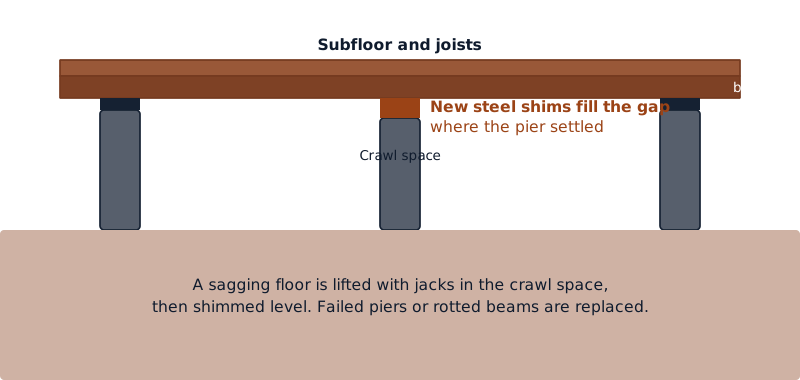
Partly. A homeowner can handle the floor frame and the crawlspace itself: finding the low spots, repairing joists, fixing ducts and keeping water out. The foundation proper, meaning the footings, piers and the beams sitting on them, is a different job. Moving it means jacking a loaded house, and the City of Houston treats shim and level work as foundation repair that needs a building permit.
Here is how the common jobs split:
| Job under the house | Homeowner? | Why |
|---|---|---|
| Measuring floor heights and mapping low spots | Yes | Needs only a level or a water level and patience |
| Sealing and insulating crawl space ductwork | Yes | Simple materials, no structural load |
| Sistering a cracked or notched joist | Yes, with care | Small lift, one member at a time |
| Adding a support under one sagging joist | Yes, with care | Only snug, never lifting the house |
| Reshimming a beam on a pier | No | Jacking a loaded beam; permitted work in Houston |
| Replacing, resetting or adding piers | No | Footings, hydraulic equipment, permit |
| Releveling the whole house | No | Staged lifts across many piers |
| Replacing a sill plate or main beam | No | Temporary shoring of the walls above |
Crawl Space Encapsulation sits in between, covered in the questions below.
How do you find out why a pier and beam floor is sagging?
Measure before you guess. Take floor heights in a grid across every room, then go under the house and match the low spots to what you find. A dip that sits right over a pier points to a sunken or tilted pier, or crushed shims. A dip between piers points to a beam that spans too far. A soft spot between beams usually means a weak or damaged joist.
How to do the survey:
- Pick a reference point. Use a doorway threshold near the middle of the house and call it zero.
- Take readings. A laser level or a clear water level tube gives better numbers than a marble. Measure every few feet and write each figure on a floor sketch.
- Draw the shape. Join points of equal height. A bowl in one area, a slope toward one wall, or a hump in the middle each tell a different story.
- Go underneath. Check each pier for tilt or cracks and each stack of shims for crushed or rotten wood, probe the wood with a screwdriver, and look for wet soil or leaking pipes, often the real cause.
Houston's ground matters here. The USDA describes Lake Charles clay as 45 to 60% clay that cracks up to 2 inches wide when dry, so piers rise and fall with the seasons.
How do you repair a sagging floor joist from the crawl space?
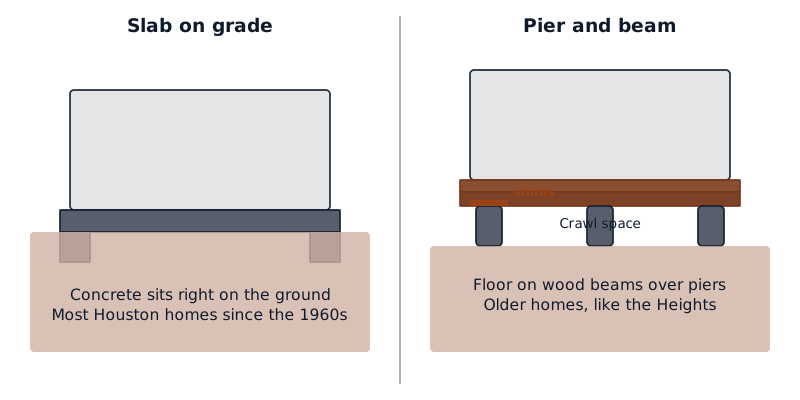
The usual DIY fix is sistering: bolting or screwing a new full-length board alongside the damaged joist so the two share the load. Before fastening, snug the old joist up gently with a bottle jack and a short post on a solid pad, only far enough to take out the sag in that one joist. Then release the jack once the sister is fixed.
The steps, one joist at a time:
- Cut the new board to the same depth as the old joist and as long as the crawl space allows, ideally bearing on the beam at both ends.
- Raise the sag slowly. Turn the jack a little and stop when the joist is straight. Pushing past straight can lift the floor above and crack tile or drywall.
- Glue and fasten the sister to the old joist with construction adhesive and structural screws or through bolts in a staggered pattern.
- Lower the jack and check the floor above with your level.
Where a plumber or an earlier owner has cut into joists, compare the damage to the limits in the 2021 International Residential Code. Notches in solid lumber joists can't be deeper than one sixth of the joist's depth or sit in the middle third of the span. Bored holes can't be larger than one third of the depth and must stay at least 2 inches from the top and bottom edges. A joist cut beyond those limits needs sistering or replacing.
If several joists in a row sag, or the floor slopes steadily toward one wall, the cause is the beam or the piers, and joist work won't change it. That becomes sagging floor joist repair by a contractor. Drainage and crack sealing, the other homeowner jobs, are in the guide to DIY foundation repair.
How do you repair ductwork in a crawl space?
Find the leaks, seal them with mastic or metal foil tape, then insulate the ducts. ENERGY STAR estimates that about 20 to 30 percent of the air moving through a typical duct system is lost through leaks, holes and loose connections, and it lists ducts in crawlspaces as a warning sign. It also says ordinary duct tape doesn't last, so skip it.
A practical order:
- Reconnect anything loose. Joints that have pulled apart are common where ducts hang from joists that have sagged or been moved during earlier repairs.
- Seal every joint and seam. Paint water based mastic over the joints, or use foil tape on clean, dry metal.
- Rehang sagging runs. Use straps wide enough not to pinch flexible duct, and keep ducts off the soil.
- Insulate. Once the leaks are sealed, wrap accessible ducts with insulation.
Never cut a joist to make room for a duct. Route the duct around it, or keep any opening inside the code limits above.
Can you level a pier and beam house yourself?
Not safely, and in Houston not without a permit. Leveling means jacking beams that carry walls, roof and furniture, then setting solid shims or new piers to hold the new height. Lift unevenly or too fast and plaster, tile, pipes and windows crack. The City of Houston's permit reports list residential shim and level jobs, so the city treats this as foundation repair.
What you can do is prepare: keep your floor map so every quote works from the same evidence, fix drainage and leaks so the new level holds, and clear the crawl space access. A contractor lifts in stages, often over more than one visit, and checks the heights each time. The process is set out in house leveling for pier and beam homes.
What pier and beam foundation repair methods and pier types do contractors use?
Most pier and beam home foundation repair uses three methods: reshimming beams on existing piers, replacing failed piers with new ones on proper footings, and adding piers to shorten long spans. Interior piers under the middle of the house are normal here, because the whole floor sits on piers, unlike a slab where interior work means breaking concrete.
For new piers, Houston contractors commonly use pressed concrete pilings, driven in sections with a hydraulic jack, which is why you'll see the terms hydraulic piers and push piers. Steel push piers go deeper; helical piers are screwed in. The Houston Press guide puts concrete piers at about $300 to $600 each and steel at $1,000 and up. The full comparison is in the guides to foundation piers and helical vs push piers.
How many piers a repair needs depends on how much of the frame has dropped and how far the beams span, so the count comes from the site visit. The best pier and beam foundation repair quote shows each pier on a floor plan. Price ranges are in pier and beam foundation repair cost.
Questions people ask
How long does DIY pier and beam repair take?
A floor survey takes an afternoon. Sistering one or two joists is a day for most people, longer if the crawl space is tight or wet. Sealing and insulating crawl space ducts takes a weekend in a typical house. Allow time to watch afterward: a full season of floor readings tells you whether the frame is stable or the piers are still moving.
Is crawl space encapsulation a DIY job?
Parts of it are. Many owners can lay and tape a ground cover themselves. Closing vents, insulating the walls and adding a dehumidifier is a larger job that changes how the space handles moisture, and it only works once drainage and leaks are fixed. If the structure needs repair, do that first, then encapsulate. The order is set out in how to repair a crawl space foundation.
Can I add a pier under a sagging beam myself?
It isn't a good idea. A pier needs a footing sized for the load and the clay, and the beam must be lifted onto it, which is the jacking work Houston permits as foundation repair. An adjustable steel post set snug under a beam can serve as a temporary support while you wait for a contractor, but it isn't a repair.
What should I look for in a sagging floor repair company?
Look for a company that measures the floor before and after, crawls the whole space, and explains the cause before the fix. The written quote should list each pier, shim and replaced member, say who pulls the permit, and set out any warranty terms in writing. Compare quotes on the same scope, using your own floor map.
This guide is one of many on Foundation Repairs Houston Quotes.
Sources
- International Residential Code 2021, section R502.8, cutting, drilling and notching (UpCodes)
- ENERGY STAR, duct sealing
- City of Houston weekly building permit report, July 2024
- USDA NRCS, Lake Charles soil series description
- Houston Press, guide to foundation repair in Houston (2026)
- This Old House, foundation repair cost guide (October 2026)
Last changed