Yes, you can mudjack concrete yourself, but only on small, separate pieces of flat work: a sidewalk panel, a path slab or a small patio section that has dropped in one piece. The job means drilling the slab, pumping a cement and soil grout underneath, and raising it no more than a quarter inch at a time while you watch a string line. It is heavy, messy work with rented equipment. Anything joined to the house belongs with a professional. For how the method works in general and what it costs when hired out, start with mudjacking and slab lifting in Houston. This page covers the do-it-yourself side: equipment, mix, steps, mistakes, and where to stop.
Can you mudjack concrete yourself?
You can, if the slab is a single sunken panel of sidewalk, path or patio, still in one piece, and not attached to your house. Concrete lifting with grout is not complicated in principle: fill the void, then build pressure until the slab rises. The hard part is control. Too much grout in one hole cracks the panel or lifts it past level, and you can't push it back down.
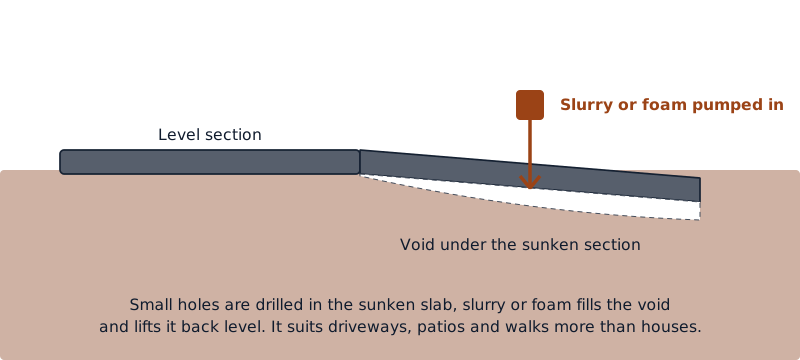
A good candidate has dropped evenly along a joint, is whole or cracked in one clean line, and has a gap you can probe under the edge. A poor one is a driveway, a garage floor, a slab poured against the house, or concrete in several loose pieces. The Missouri Department of Transportation (MoDOT), which mudjacks highway slabs, states that badly cracked or broken slabs cannot be raised effectively.
If you are weighing grout against expanding foam for the same job, the homeowner's version of that choice is on DIY foam foundation repair.
What equipment do you need for DIY mudjacking?
You need a way to drill holes through concrete, a pump that forces grout under pressure, a mixer, a hose and nozzle that seals into the hole, and tools to watch the lift: a string line, a straightedge and a level. Most people rent the pump and mixer, because buying a mudjack pump for one panel makes no sense. You also need eye, hand and breathing protection.
| Item | What it does | Notes |
|---|---|---|
| Rotary hammer drill and masonry bit | Bores the injection holes | Match the bit to the nozzle size |
| Mudjack or grout pump | Pushes grout under the slab | Rented; check hoses for wear before you start |
| Nozzle and hose | Seals into each hole | The person on the nozzle wears goggles |
| String line, straightedge, level | Shows how far the slab has risen | Set the line before you pump |
| Respirator, gloves, goggles | Protects you from dust and grout | Wear them from the first hole |
OSHA names drilling into concrete as a source of fine crystalline silica dust, which can cause silicosis, an incurable lung disease. Drill with water or dust extraction and wear a respirator. MoDOT warns that a hose failing under pressure can injure people nearby, which is why worn hoses get replaced and the nozzle handler wears goggles.
What is the right mudjacking mix?
The classic grout is clean topsoil or loam mixed with Portland cement and water. MoDOT uses 9 sacks of cement per cubic yard of soil, or 6 sacks per cubic yard where fine sand or agricultural lime replaces the soil. Water is added until the mix is thin enough to pump but stiff enough to lift. For a homeowner, the consistency matters more than the exact recipe.
The soil must be free of stones and roots, which jam the pump. MoDOT uses a stiffer grout to raise a slab than to fill voids, but never so stiff that it piles up around the hole instead of spreading. Mix small batches you can pump before they set.
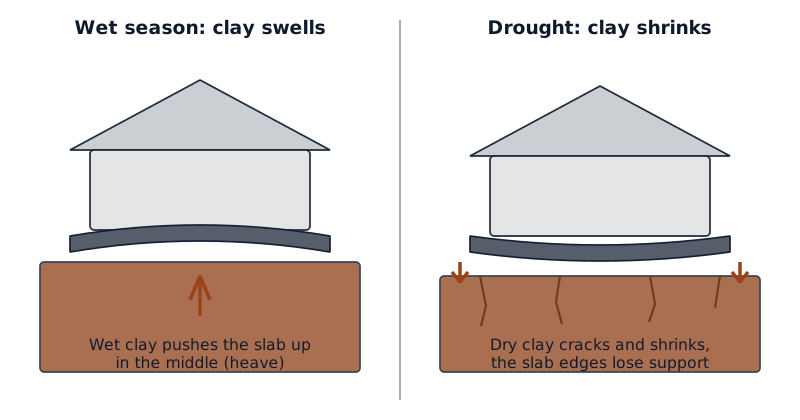
Houston's own clay is a poor base material. The USDA describes the Lake Charles clay of the Houston area as 45 to 60% clay that cracks wide open as it dries. Use fill sand or screened topsoil instead.
How do you mudjack a sidewalk slab, step by step?
Mark the sunken area, set a string line at the finished height, drill holes in a spread pattern, then pump from the deepest point outward, lifting no more than a quarter inch at each hole per turn. Check the line after every turn, plug unused holes, and fill all holes with mortar when the slab is level. A single panel is a full day's work.
- Check what's underneath. Before drilling, find out where water, gas, irrigation and cable lines run. Never drill a panel you can't account for.
- Pick your timing. MoDOT prefers cool weather in spring or fall, when slabs aren't at full expansion.
- Set the string line across the panel from the level concrete on each side.
- Lay out the holes. Grout spreads roughly in a circle from each hole, so space them evenly. At a joint, MoDOT drills about 2 inches from the edge and uses those holes last.
- Start at the low point. Pump the hole nearest the middle of the dip first, then move back and forth outward on each side.
- Lift a quarter inch, then move. MoDOT's rule is no more than 1/4 inch at each hole at a time. You cannot judge the lift by how much grout went in, so watch the slab and the line, not the pump.
- Plug between turns. Push a wooden plug into each hole after pumping it.
- Finish the ends last. Once the panel meets the line, pump a very thin grout through the end holes to fill the wedge-shaped gap at the joint.
- Patch and cure. Clean out every hole, fill it with cement and sand mortar, and keep weight off. A Houston guide puts grout curing at 24 to 72 hours.
What goes wrong with DIY mudjacking?
The usual failures are over-lifting, cracking the slab, grout escaping through a joint or along the edge, and a panel that drops again within a year. Most come from pumping too fast or skipping the string line. The last one comes from not fixing the reason it sank: water washing soil out from under the concrete, or clay shrinking in a dry spell.
| Problem | Usual cause | How to avoid it |
|---|---|---|
| Slab lifted past level | Too much grout in one hole | Quarter inch per turn, watch the line |
| New crack across the panel | Lifting one side far ahead of the other | Rotate between holes |
| Grout squirting out at a joint | Mix too thin or pump pressure too high | Stiffen the mix, slow down |
| Panel sinks again | Drainage left unfixed, or moving clay | Fix gutters and slope before you lift |
If you crack a panel, stop: a broken slab won't lift evenly. For comparison, This Old House puts a typical professional mudjacking or slabjacking job at $550 to $1,300 nationally; the breakdown for Houston jobs is on mudjacking cost.
When should you hire a concrete lifting contractor instead?
Hire it out when the slab is a driveway, a garage floor, a pool deck, a porch or patio poured against the house, or any part of the house slab itself. Also hire it out when the concrete is broken in several places, when the sinking keeps coming back, or when you see cracks in walls or sticking doors inside. Those point to the foundation, not the flat work.
Why the line sits there in Houston:
- The house slab is a different job. The Post-Tensioning Institute describes post-tensioned slabs as a foundation for homes on shrink-swell soils like Houston's, with steel tendons under tension cast inside. Drilling into one yourself risks hitting a tendon.
- Permits. City of Houston permit records list foundation repair as building permit work. Lifting a separate sidewalk panel is not foundation repair, but lifting or leveling the house slab is, and inside the city it runs under a permit.
- The soil keeps moving. Grout fills a void; it doesn't stop clay from swelling and shrinking. A house that keeps settling needs foundation piers, set out with the other slab options on the hub page.
Other jobs a homeowner can take on are on DIY foundation repair in Houston, and grout against foam is compared on polyjacking vs mudjacking.
When you'd rather not rent a pump, we'll arrange a visit from a local concrete leveling contractor, who looks at the slab and the drainage and gives you a written price before any drilling starts. Ask for a slab lifting quote.
Questions people ask
Can you mudjack concrete without a pump?
Not properly. Grout has to go in under pressure to build lift, and pouring it into a hole by hand only fills the gap near that hole. Hand-filling a void at the edge can slow further sinking, but it won't raise the slab. To lift, rent a grout pump or switch to a foam kit for a small panel.
How long does DIY mudjacking take?
Plan on a full day for one or two sidewalk panels, including drilling, mixing, pumping in slow turns and patching. The grout then needs to cure; a Houston guide puts that at 24 to 72 hours, so keep foot traffic light and anything heavy off it for that long.
Is DIY mudjacking cheaper than hiring it out?
Sometimes, for one small panel, once you add up pump and mixer rental, cement, fill, a masonry bit and protective gear. For anything bigger, the saving shrinks quickly. A national guide puts a typical professional job at $550 to $1,300, and a panel cracked during a DIY lift usually has to be replaced, which can wipe out the saving.
Does DIY mudjacking need a permit in Houston?
Lifting a separate sidewalk or patio panel on your own property is not foundation repair. Lifting or leveling the house slab is, and City of Houston records show foundation repair runs under a building permit. If the concrete sits in a public sidewalk or near the street, ask the city before you drill. Outside Houston, check your city's building department.
The rest of our guides start from Houston foundation repair.
Sources
- Missouri Department of Transportation, Engineering Policy Guide 570.5, Mudjacking (Slab Jacking)
- OSHA, Crystalline Silica
- Post-Tensioning Institute, Slab-on-Ground
- This Old House, foundation repair cost guide (October 2026)
- Houston Press, guide to foundation repair in Houston (2026)
- USDA NRCS, Lake Charles soil series description
- City of Houston weekly building permit report, July 2024
Last changed